Book festivals are booming both here and overseas. The Auckland Writers Festival held last week again broke records for attendances and book sales.
One international guest author was heard saying it was bigger than others he had attended. Most major cities prefer to stagger touring authors and book promotions. Annual festivals are the exception, with Singapore, Accra, Edinburgh, and Brooklyn in New York among notable examples.
Most Australian cities have festivals, allowing publishers and authors from the other side of the world to coordinate their promotional tours. While the numbers for Auckland are impressive, it may be getting too big to avoid the downside of indigestion.
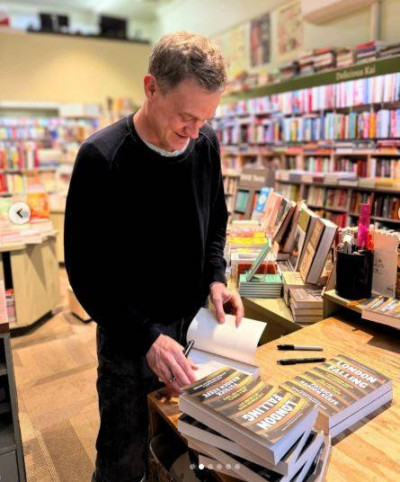
Patrick Radden Keefe at Unity Books, Auckland.
Overlapping sessions reduce choice – Auckland had four or five simultaneous sessions running six times a day – and costs soon mount at $30 a pop, before discounts, if you attend two or three a day.
That didn’t keep the crowds away, although the Aotea Centre venue, with its single large auditorium and array of much smaller rooms, may have outlived its purpose now the new International Convention Centre at SkyCity is finally open.
I have seen no financial details, but the organisers said ticket sales were up 15% on the previous year, 90,000 people attended, and 13,000 books were sold. At between $30 and $40 for an average book, that’s easily a spend of half a million dollars.
Many of the international authors were at peak bestsellerdom. Only Ian McEwan (What We Can Know) and Maggie O’Farrell (Hamnet) could not appear in person. New Yorker writer Patrick Radden Keefe made several appearances, confirming his place as the world’s top-selling non-fiction author.
London Falling has been top of the general hardback list in the Sunday Times (London) for the past month. It was also the festival’s best-selling title. His exposé of the Sackler drug dynasty, Empire of Pain, is an even better book.
In fiction, Mike Herron is riding high on Apple TV’s adaptation of his Slow Horses spy saga, the latest of which is Clown Town. Ireland’s Roddy Doyle had an equally large stack for sale, including one adapted for the screen, The Commitments, and a Booker Prize winner, Paddy Clarke Ha Ha Ha.
The latest Booker winner, David Szalay, was present to talk to Doyle, the chair of judges, about the novel Flesh and what it’s like to win one of the book world’s highest-profile awards.
Canadian Yann Martel (Life of Pi) led a delegation of writers from that country. I bought a copy of Maria Reva’s Good Citizens Need Not Fear, based on her early years living in Ukraine during the Soviet era.
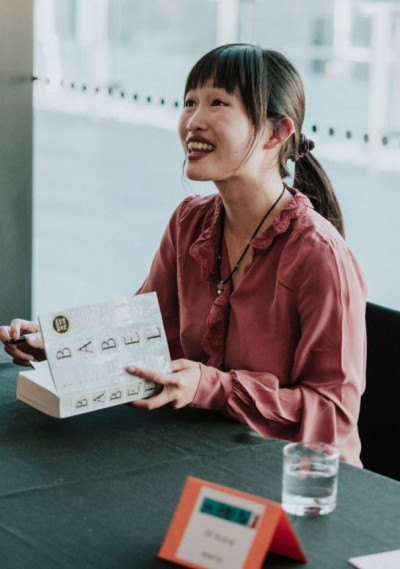
Rebecca Kuang. Photo: Michelle Porter
The closest I got to fiction fandom was seeing RF (Rebecca) Kuang, who is still not 30 but already has six titles to her credit and another on the way. The first three are a trilogy of war-related fantasy aimed at young adults (I presume) with a Chinese setting.
Kuang was born in Guangzhou but emigrated with her family to the United States when she was four. She has had a stellar academic record – a similar profile to Carrie Sun, whose Private Equity was reviewed here.
I read Kuang’s entertaining Yellowface, her fifth novel, at Christmas based on reviews for its satirical campus setting and strong autobiographical overtones. It’s about two female friends who want to be writers. One, an overachieving Asian American, dies in a freak accident. The other steals her identity (and manuscript) and publishes it as her own with catastrophic consequences.
Katabasis and Babel, her other current titles, don’t appeal and look too intellectual. Next on the list will be Taipei Story, set in a Taiwanese language school for foreigners and sounding more like Yellowface.
My two current affairs sessions involved China and Afghanistan. Previous experience at the festival is that one word – ‘Trump’ – is the best way to wind up the audience. Sure enough, former foreign correspondent Barbara Demick rose to the bait and had a one-word piece of advice to the Potus: “Resign!”
After that, he was hardly mentioned, as Demick chatted with an old friend and near neighbour in Beijing, Anna Fifield, about life as a foreign correspondent in China. Both had written books about North Korea, one of the world’s worst dictatorships, and knew more about global issues than their audience.
Demick’s Nothing to Envy (2009) was one of the first books to expose the horrors of the Hermit Kingdom through the eyes of defectors, while Fifield has published a biography of Kim Jung Un, the third in the notoriously dynastic Kim family.
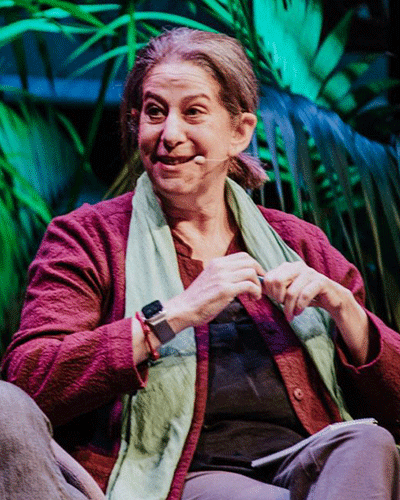
Barbara Demick. Photo: Michelle Porter.
Their topic, however, was Demick’s Daughters of the Bamboo Grove, a personalised account of China’s one-child policy. She did not hold back in describing how a twin girl was abducted by the birth control police and sold as an orphan to an American couple.
Her approach to writing about this state-sanctioned child trafficking racket is to focus on individuals whose stories can be told. Demick tracked the twins down as adults and keeps in contact. It’s a story full of drama and human interest, leaving you wanting more from an interview. The same could be said for BBC chief international correspondent Lise Doucet, another skilled storyteller and communicator.
Unlike Demick, Canada-born Doucet was new to book-writing and revealed much about how they are shaped by editors and publishers. Doucet didn’t want to write a standard broadcaster’s memoir, two of which have appeared locally this year (all three appeared in a separate session to the one I attended).
Instead, she opted to tell the history of modern Afghanistan through the prism of that country’s first premium hotel, the Inter-Continental in Kabul. This is the same hotel that earned bravery medals for New Zealand SAS soldiers, who fought six suicide bombers in 2018. (A blow-by-blow account is told in Ron Crosby’s Keep Calm, reviewed here a few weeks ago. Strangely, this book was not featured at the festival.)
Doucet first arrived in Kabul on her 30th birthday, Christmas Eve, 1988, to cover the Mujahideen insurgency funded by the West against a Soviet-installed regime. The mild-mannered King Zahir Shah had been overthrown by his cousin in 1973, followed by a series of bloody coups until the Soviet invasion in 1979.
The king had built the hotel on a hill overlooking Kabul in 1969. A ‘golden era’ followed as the country welcomed the world’s intrepid rich and famous as well as hippies seeking a high on locally grown poppies. Women wore bikinis in the pool while gin and tonics were served at the rooftop bar.
The Finest Hotel in Kabul: A People’s History of Afghanistan begins in the near present as hotel staff prepare for a summer wedding on August 15, 2021. The Taliban were on the verge of taking Kabul and US President Joe Biden was still vowing to withdraw American troops by September 11 that year.
The hotel, ringed with razor wire and other defences, was considered impregnable. Doucet recounts how staff reacted to news the Afghan president had fled, that few guests turned up to the wedding, and the dreaded Taliban were back in power.
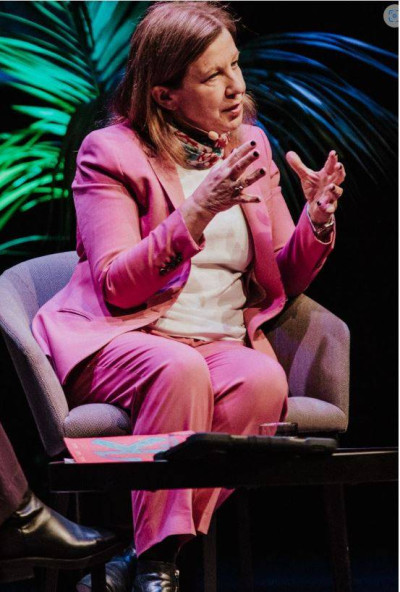
Lyse Doucet. Photo: Michelle Porter
Doucet talked about the colourful characters she knew – front desk managers, housekeepers, chefs, and cocktail mixers; their stoicism, friendliness and, in some cases, their new lives in the West. Some of their stories weren’t told in the book for fear of the consequences. It is being translated into the local languages, Dari and Pashto.
Like Demick, Doucet had plenty of grim content as the second Taliban regime extinguished the gains for women since 2001. For two decades, the Taliban unleashed a wave of assassinations and suicide bombings that ended in the Nato withdrawal.
Both authors indicated they were unlikely to return to China or Afghanistan in today’s circumstances. But they had committed their experiences to paper and could share them in person with eager audiences.
Recommended reading:
Daughters of the Bamboo Grove: China’s Stolen Children and a Story of Separated Twins, by Barbara Demick (Text Publishing).
The Finest Hotel in Kabul: A People’s History of Afghanistan, by Lise Doucet (Hutchison Heinemann).
Yellowface, by Rebecca F Kuang (The Borough Press/HarperCollins).




