The National Business Review has obtained settlements from the Financial Markets Authority, Serious Fraud Office, and Department of Internal Affairs after each admitted to sharing articles in an alleged breach of NBR’s copyright and subscription terms and conditions.
NBR has also sought $50,000 in damages and legal costs from Inland Revenue and is entering into talks on damages with the Ministry of Business, Innovation, and Employment (Mbie), while legal action has been filed against investment platform Snowball Effect for alleged breaches of NBR’s copyright and subscription terms and conditions.
Since last October, NBR owners Todd and Jackie Scott have been pursuing businesses and government departments for alleged breaches of NBR’s copyright and subscription terms and conditions. Those have mostly been through entities sharing small numbers of subscriptions widely among their staff or by using subscriptions to share copied versions of articles to non-subscribers.
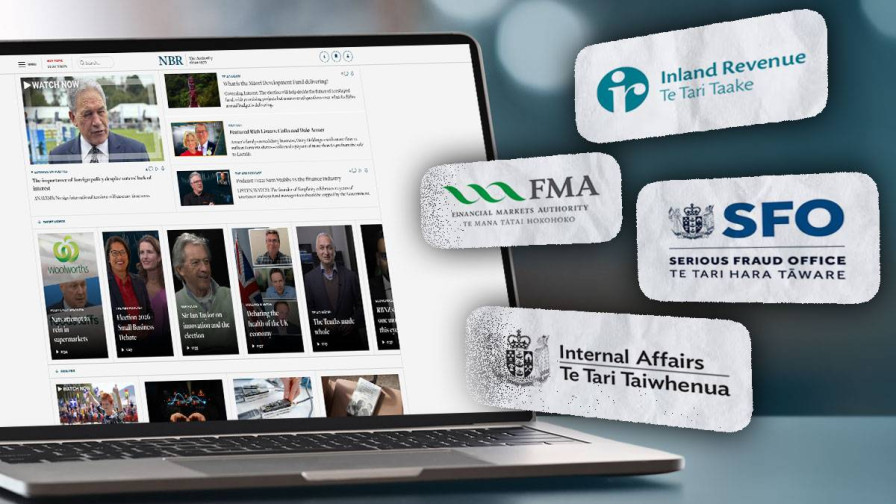
NBR’s terms and conditions specify that a subscription cannot be shared with others and to do so is a breach of copyright. The Chief Ombudsman in July found the sharing of NBR content by Mbie was unreasonable, appears contrary to law, and likely harmed NBR’s commercial position.
NBR has to date secured settlements from 19 companies, resulting in payments for damages of more than $200,000, as well as legal costs. That has ensured they are paying fairly for their subscriptions and allowed NBR to keep subscription prices steady for everyone, while also investing in our journalism – senior reporter Anan Zaki joins the publication, based in Christchurch, today, while video content producer John Whiteside joined last week.
Now, NBR has also secured settlements from the FMA, SFO, and DIA. The terms of the settlements are confidential.
NBR owner Todd Scott commented: “Copyright theft isn’t clever. It isn’t a loophole. And it certainly isn’t victimless. Every person or organisation that takes journalism they haven’t paid for is effectively asking our loyal, paying members to subsidise them.
“We won’t allow that. If you choose to steal our journalism rather than pay for it, we will hold you accountable. Not because we need to. Because our members shouldn’t have to pay for people who think the rules don’t apply to them.”
Widespread
NBR had in January sought information from 11 government agencies about their use of NBR subscriptions from 2020 onwards, under the Official Information Act. That followed Inland Revenue last October disclosing it had on several occasions used one subscription to NBR to copy and paste articles into Microsoft Word documents, before sharing those documents with hundreds of staff.
The OIA requests revealed widespread alleged breaches of NBR’s copyright and subscription terms and conditions. Collectively, the departments admitted at least 230 articles were inappropriately shared with thousands of staff.
In many instances, the departments could not specify exactly how many people accessed an article, or even the full extent of the number of articles shared.
Mbie admitted sharing at least 149 articles; IRD at least 43 articles; DIA at least 23 articles; and the SFO at least 15.
The FMA initially denied any breach but, on further investigation, admitted to the Ombudsman there were seven instances of FMA staff members sharing either screenshots or PDFs of NBR articles. It apologised to NBR and acknowledged it should not have happened.
The DIA, meanwhile, has admitted as many as 210 unauthorised DIA staff accessed NBR articles in 2025, and 144 people in 2024.
Contrary to law
In April, NBR complained to the Ombudsman about the initial responses and conduct of each government department.
In July, Chief Ombudsman John Allen issued a final opinion on the complaint regarding Mbie, finding the department’s "inappropriate”, “systemic” practice of sharing NBR content was “unreasonable and appears to be contrary to law”.
The Ombudsman recommended Mbie:
- apologise to NBR for its sharing of NBR content outside of its terms and conditions;
- provide NBR with a report on the extent of its sharing of its content (once it has finished processing the OIA request);
- undertake periodic monitoring to ensure that this practice is not continuing; and
- engage with NBR about an appropriate remedy for this practice.
Allen said at the time he was concerned the sharing occurred, and that it did so at “such frequency”.
“In my opinion, the type of sharing was clearly not how subscriptions were reasonably intended to be used and appear to breach NBR’s terms and conditions. The level of sharing indicates systemic practice that appears to have harmed NBR’s commercial position.
“It is inappropriate for a government agency to breach conditions at what appears to be a systemic level.
Mbie had responded to NBR’s initial OIA request on February 25, detailing extensive breaches over a sustained period. Further responses were provided last week, as well as an apology and promise to send a proposal to rectify the matter this week.
NBR is also seeking damages from Inland Revenue and has filed legal action against Snowball Effect.
A total of $50,000 is being sought from Inland Revenue, including legal costs. An OIA response last week confirmed Inland Revenue had, in addition to the earlier instances of sharing, found less than 10 instances where information sourced from NBR’s annual Rich List appeared to have been copied and pasted into documents or emails within its high wealth compliance team. There were also two instances where Rich List wealth estimates had been incorporated into working spreadsheets.
NBR cannot comment further on the Snowball Effect claim as that matter is now before the courts.




