The world’s largest media and entertainment business, The Walt Disney Company, is facing the future under its ninth chief executive in its 102-year history.
He is Josh D’Amaro, who runs the theme parks, cruise ships and consumer products division. His appointment followed a face-off with Disney’s entertainment co-chair Dana Walden, who has been rewarded with a newly elevated role giving her oversight of all its movies and streaming series.
Just before the CEO announcement, the company produced a solid December quarter result as revenue surged in its streaming services, Disney+ and Hulu. However, its ESPN sports, theme parks and cruise ship businesses reported reduced income and higher costs.
D’Amaro will be charged with continuing Disney’s shift toward streaming while managing traditional television’s expected continued decline, and further stoking growth in what are called its 'experiences' business. These include the global chain of theme parks, which gave Disney its moniker as the “Magic Kingdom”, and Disney Cruise Line, which is pulling out of the Australasian market this year due to high operating costs and poor sales.
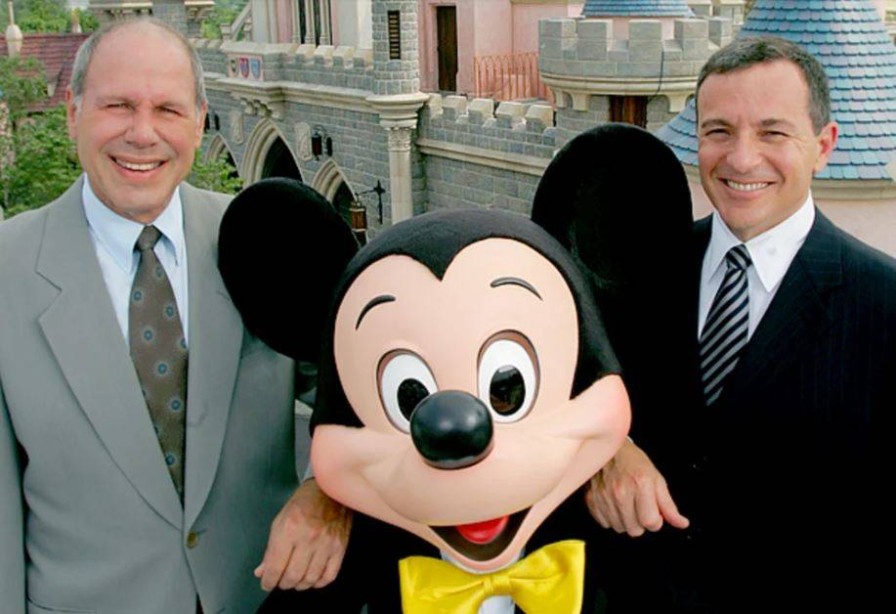
Michael Eisner and Bob Iger with Mickey Mouse at the opening of Hong Kong’s Disneyland Park in 2005.
The US$200 billion ($330b) corporate behemoth is largely the creation of two chief executives, Michael Eisner and his successor, Robert (Bob) Iger. Eisner took the reins in 1984, reversing the company’s decline with the international expansion of its theme parks and a revival of its animation studios from 1989 to 1999.
Movie hits
A string of movie hits, both animated and conventional, established Disney as the top Hollywood studio, a position it retains. In 1995, Eisner engineered a takeover of Capital Cities/ABC, America’s top television network. At US$19.5b, it was the second-largest corporate deal in US history.
Iger was then head of ABC, having worked his way to the top after joining as a floor assistant at the Manhattan broadcasting studios in 1974. His story is told in The Ride of a Lifetime, a memoir-cum-leadership book first published in 2019. It has just been reissued as a Penguin paperback.
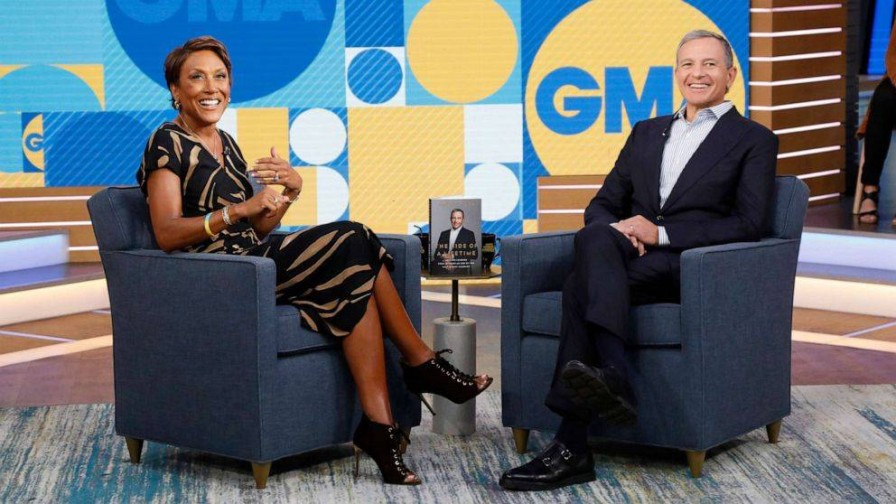
Good Morning America host Robin Roberts interviewed Bob Iger about his book in 2019.
It remains one of the best books about American business if you’re looking for leadership tips and an account of corporate life at the very top.
Eisner struggled to maintain control of the sprawling Disney empire after the ABC acquisition. His choice of a second-in-command, talent agent Michael Ovitz, was a disaster. The Disney board, usually comprising other chief executives and luminaries such as US Senator and Northern Ireland peacemaker George Mitchell, promoted Iger to president and chief operating officer.
Iger came from a culture at ABC where decision-making occurred at divisional level. Disney, by contrast, had a politburo, called Strategic Planning, which made all the calls.
“They were a completely centralised, process-oriented company and we [ABC] instinctively bristled at the way they operated,” Iger observes. “They had also never acquired a big company before, and they’d given very little thought as to how to do it with sensitivity and care.”
Big picture
In his new role, Iger set out on a path that eventually led to Eisner leaving the company. Iger praised Eisner’s ability to see the big picture in Disney’s future, as well as his belief that “micromanaging is underrated”.
Mitchell replaced Eisner as chairman after a shareholder revolt led by Roy Disney, Walt’s nephew and self-appointed keeper of the Disney legacy. Iger’s priorities were to restore the relationship with Roy Disney and Steve Jobs, the Apple Computer co-founder and chairman of Pixar, an animation startup involving ex-Disney creatives.
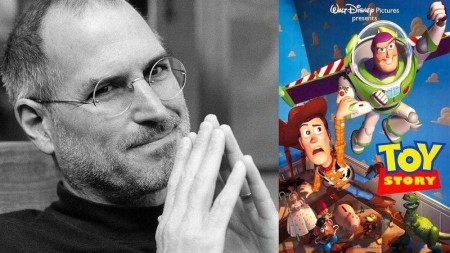
Pixar chairman Steve Jobs and its box office hit Toy Story.
Pixar was originally part of Star Wars creator George Lucas’ Lucasfilm and had a short-term distribution arrangement with Disney. The arrangement launched a series of box-office hits, starting with Toy Story (1995). Iger had to persuade Jobs to sell, even though the technology whizz despised Disney and its Byzantine ways.
Iger eventually succeeded by promising he would change Disney into a decentralised operation, and by pushing his belief that the creativity in Pixar – unmatched by Disney’s own animation studio – would carry both companies forward. The deal was worth US$7.4b, made through a share swap and US$1b Pixar held in cash.
Terminal cancer
Just minutes before signing the deal, Jobs confided he had terminal cancer, suggesting Iger could pull out. But it was too late. Jobs had also showed Iger a prototype for a video version of Apple’s iPod, which would allow movies, TV shows, sports, and news to be seen on a handheld device.
This persuaded Iger that technology would decide the future of the media and entertainment industry. He gave Jobs and Apple an undertaking that all Disney output would be available for what turned out to be a whole new way consumers would access their entertainment needs.
(Eisner’s tumultuous final years at Disney are recounted in James B Stewart’s DisneyWar (2005). Pixar’s story is told in Ed Catmull’s Creativity, Inc (2014).)
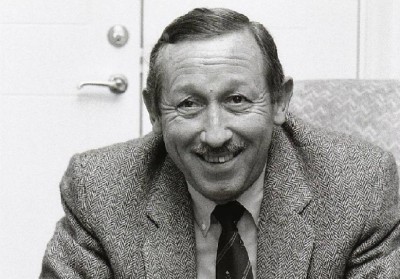
Roy E Disney, keeper of the Disney legacy until his death in 2012.
Iger brought Roy Disney back into the fold as “director emeritus” and implemented a third priority, curbing the role of Strategic Planning, cutting its staff of 65 MBAs to just 15. But Iger wasn’t finished, by a long chalk.
Disney, in his view, needed more bulk in its generation of content. The targets: Marvel Entertainment, home of comic superheroes, and Lucasfilm. Both enterprises had difficult owners in Isaac Perlmutter and George Lucas, respectively. They did not see their creations prospering under Disney. But both eventually folded, with Perlmutter’s tyrannical ways being his undoing.
He badly treated his creative staff, led by Kevin Feige, and was eventually sacked from operational control by Iger. The 2009 deal was worth US$4b, money well spent when you consider how much its films have contributed to Disney over nearly two decades.
Lucas figured he should get as much as Pixar but settled for a smidgen over the Marvel deal in 2012. Star Wars had far less potential and nothing in development compared with Marvel’s prodigious output under Feige. Lucasfilm also gave Disney access to the Indiana Jones franchise and visual effects studio Industrial Light & Magic.
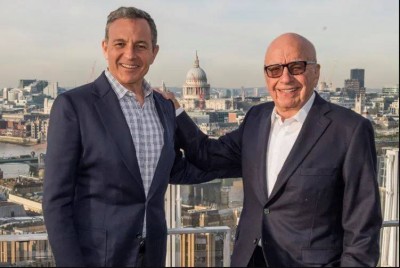
Bob Iger and Rupert Murdoch announced their merger deal in London.
Iger’s third and last major acquisition came after a phone call from Rupert Murdoch. He was considering an exit from the movie business to concentrate on his media interests. Disney’s 2019 acquisition of 21st Century Fox for US$71.3b included the movie and television operations (but not the Fox news channels), National Geographic, and a stake in Hulu.
Iger completed The Ride of a Lifetime just before he stepped down after 15 years as CEO in February 2020. But his retirement was short-lived and is not included in an updated version.
For the record, Iger, as executive chairman, handed the reins to Bob Chapek, who headed the theme parks division and had become a top deputy to Iger. Iger stayed on for more than a year and a half to advise Chapek and smooth the transition.
Chaotic period
But as the Covid-19 pandemic unfolded, the two men clashed frequently and intensely, leading to a chaotic period that culminated in the board ousting Chapek in November 2022. The company brought back Iger for a second stint as CEO. That effectively ended this week as Iger’s successor was named.
D’Amaro will move up to the top job on March 18, while Iger will serve as senior adviser and board member until his contract ends on December 31.
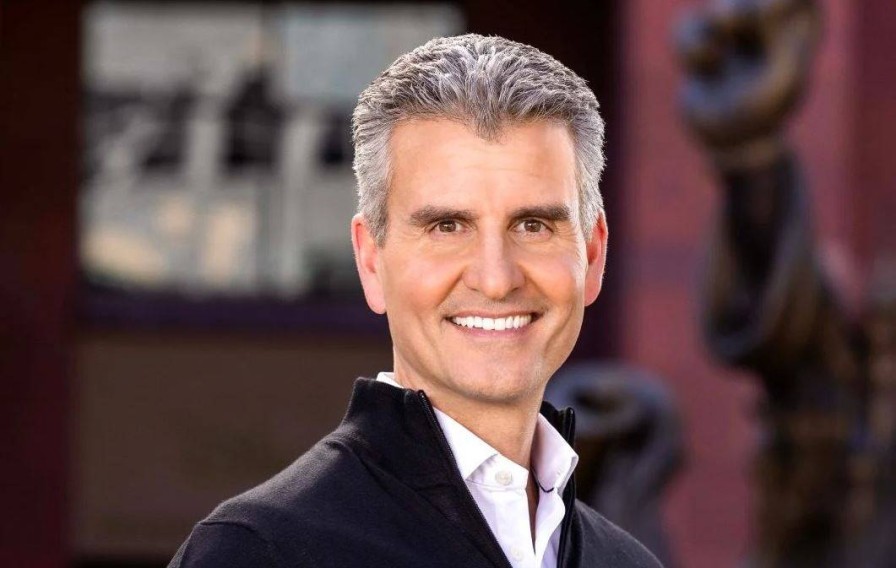
Josh D’Amaro was named CEO of Disney this week.
Disney remains at the top of the industry tree, while major changes are continuing. Warner Bros Discovery announced a US$72b deal with Netflix, which plans to buy its studios and HBO Max streaming service. Paramount, meanwhile, is seeking to buy all of Warner.
The financial stakes have given some comfort to Iger in defending his last acquisition at a similar amount for assets that included the Avatar franchise and the FX cable network. In other changes at Disney, Lucasfilm president Kathleen Kennedy has stepped down.
She was criticised for introducing policies that downgraded the stereotypically male superheroes in favour of younger female ones in both the Star Wars and Indiana Jones franchises.
As a result, audiences declined and critics panned the quality, although industry analysts said these were due more to a saturation of content, cancellation of projects, and inconsistent leadership. The challenge at Disney will be whether D’Amaro will use Iger’s insights to avert a repetition of the ill-fated Chapek episode.
The Ride of a Lifetime, by Robert Iger (Penguin Books)
Nevil Gibson is a former editor-at-large for NBR.




