One of the first tragedies of the 21st century was the loss of human freedoms in Hong Kong, a special administrative region in the People’s Republic of China. It was handed over as a former British colony in 1997 with the promise that it would retain its political and economic system for 50 years.
That promise was not kept, and authoritative authors, such as Michael Sheridan’s The Gate to China (2022), assert the Chinese Communist Party (CCP) negotiators had no intention to do so. Throughout its dealings, the CCP employed the tactics of Sun Tzu that all warfare is deception.
In the latest blow, London’s The Times reported that police arrested the staff of a bookshop for selling a biography of Jimmy Lai, the former newspaper proprietor who was imprisoned in February for 20 years under the national security law.
Pong Yat-ming, founder of Book Punch, was detained along with three female employees on suspicion of “selling seditious publications” and violating the Beijing-imposed Safeguarding National Security Ordinance.
The book is The Troublemaker: How Jimmy Lai became a billionaire, Hong Kong’s greatest dissident, and China’s most feared critic, by Mark Clifford, an American human rights activist and former journalist. It was published in the US late last year.
The Times said independent bookshops had become havens of liberal thought in an increasingly repressive territory. “With the imposition of the security laws, newspapers, television and online media have become wary of direct and indirect criticism of the authorities,” it said.

The original Causeway Bay bookshop in Hong Kong.
In 2015, five employees of Causeway Bay Books, which sold books critical of the CCP, went missing, apparently after being abducted by the mainland Chinese authorities. Some bookshops have been forced to close, including Mount Zero. It was repeatedly targeted with inspections for “illegally occupying government land” – a small, tiled area of land in front of the shop where people could sit and read.
No outright ban
But few books are banned outright. Among the consistent bestsellers are Cantonese translations of the diaries of Lord Patten of Barnes, the last British governor of Hong Kong, George Orwell’s Nineteen Eighty-Four, Aldous Huxley’s Brave New World and Timothy Snyder’s non-fiction work On Tyranny.
Remarkably, Google tells me the works of Frank Dikötter, the Dutch historian once based at the University of Hong Kong and now at the Hoover Institution in California, are still available. Over the past 20 years, since he moved to Hong Kong, he has produced a definitive history of the CCP. Known as The People’s Trilogy, it comprises Mao’s Great Famine (2010), The Tragedy of Liberation (2013), and The Cultural Revolution (2016). Though not published in chronological order, they cover the years 1945-76.
Since then, China After Mao (2022), reviewed here, brings the history up to date, while his latest, Red Dawn Over China, has just appeared and covers the rise of the CCP from its origin in 1921 to its civil war victory in 1948 and the conquest of Tibet in 1950.

Professor Frank Dikotter. (Source: Hoover Institution).
Among Dikötter’s other books are The Age of Openness: China Before Mao (2008), a history of the Republic of China up to its flight to Taiwan, and How to Be a Dictator: The Cult of Personality in the Twentieth Century (2019), which profiles the likes of Lenin, Stalin, Mussolini and Hitler.
All reflect Dikötter’s methodology of archival history based on the written word, especially those held in state institutions. In the case of China, where archives are closely controlled and officially sanctioned histories are little more than propaganda, Dikötter was well placed to take advantage of an opening from 1981-89.
The Central Party Archives produced well over 300 volumes of original documents from 1923 to 1949. Each volume ran to 400-600 pages. They were not made public, but copies found their way to Hong Kong. These were supplemented by Dikötter’s use of historic records in Taiwan and those of the Comintern, the international communist organisation based in Moscow.
These offered Dikötter unparalleled insights into a tumultuous period of China’s history. Yet, paradoxically, they also demonstrated how marginal the role of the CCP was from its foundation to the end of World War II.
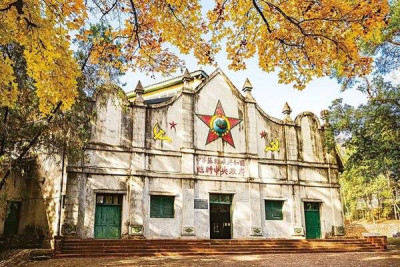
A Ruijin memorial park to the Chinese Soviet Republic, 1931-34.
Never popular
Communism was never popular in China and CCP membership fell well below rates of Western Europe in the 1930s and 1940s. At a ratio of one to 1700 people (a likely inflated number), CCP membership in 1940 was roughly equivalent to that of the communists in America.
This was despite the theoretical appeal of socialism to China’s hundreds of millions of poor peasants and the efforts of the Soviet Union to build resistance against capitalists and imperialists.
Those familiar with Dikötter’s work know what to expect: a detailed account of how the CCP used Sun Tzu’s dictum, which is quoted in the epigraph, to impose an ideological creed using the most violent means possible.
Dikötter is not a man of few words. He expands the definition to the use of “unrestricted warfare, devoid of any rules”. The tactics of feign, lie, deceive, retreat, hit, run, and sabotage; anything to achieve the desired ends.
Red Dawn Over China is a play on Edgar Snow’s classic, Red Star Over China (1937), which established the myth of Mao Zedong as the idealistic leader of a ragtag army that would later conquer a corrupt nation of warlords and Japanese invaders on the way to creating a progressive utopia.
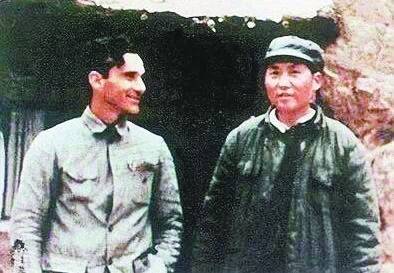
Edgar Snow and Mao Zedong. (Source: Peking University.)
More lives
That is still the narrative encouraged by the CCP, despite its archives that reveal a much more sinister and horrific story that has cost more lives than Hitler and Stalin combined ever achieved.
Given the relative unimportance of the CCP’s role in China until the end of World War II, it is remarkable that Dikötter found enough interesting material for a 360-page book (including sources, bibliography and index).
But he does so by focusing on the few areas of China where the CCP briefly established a Soviet republic in the early 1930s, and its many failed attempts at gaining control of militant, urban-based trade unions.
This is consistent with Dikötter’s theme that far from winning the hearts and minds of workers and peasants, the CCP was dependent on arms and supplies from Stalin. Its tactics were about 'scorched earth' and taking what little the peasant masses had in the countryside.
‘Trail of destruction’
Contrary to Marxist dogma, Dikötter says China’s rural economy had no landlords, aristocrats or serfs. But this didn’t stop the Red Armies from using tactics that “left a trail of destruction, surviving on loot and ransom as they laid siege to towns, burning government buildings, killing so-called ‘class enemies’, seizing their property and distributing it to the troops”.
The most extreme use of these tactics was employed at the Jiangxi Soviet based in Ruijin, and others in Fujian, Hunan, Hubei, Anhui, and later Sichuan. These covered just 150,000 square kilometres, or 2% of China’s territory.
Jiangxi lasted just three years, from 1931-34, as policies of self-sufficiency, including the printing of its own worthless currency and mandatory war bonds, resulted in famine. Purges, another feature of communism, were common, and so was the use of hand-tied civilians and Red Guard children as cannon fodder at the head of attacking armies during a siege.
This is grim reading, equal to that of Ukraine’s Holodomor, as Dikötter tracks the CCP’s subsequent journey through China’s hinterland – the much-hyped Long March – while Chiang Kai-Shek’s Nationalists carried the burden of fighting the Japanese Army.
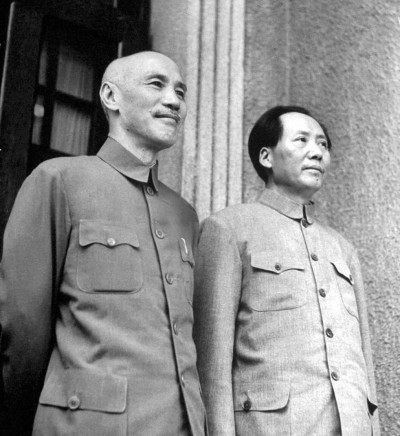
Chiang Kai-shek and Mao Zedong during the ceasefire talks in 1946.
War declared
Japan had seized Manchuria after provoking the Mukden Incident in 1931, before declaring war in 1937. The region became critical in the CCP’s success after 1945 when Stalin sent in a million-strong army that locked out the Nationalists and turned the tide in favour of Mao.
American culpability in the CCP’s victory is not omitted, with President Harry Truman persuaded that the communists were “not doctrinaire ideologists, but merely rural reformers who could help shape a democratic China”.
A ceasefire in 1946, brokered by General George Marshall with a no-longer-trusted Chiang, gave Mao the breathing space he needed for more backup from Moscow, assisted by Truman’s ban on supplying more arms to the Nationalists. Three years later, with many more atrocities as the CCP honed its tactics against a weakened and demoralised enemy, the battle in Manchuria was won with the fall of Changchun in the northeast.
Dikötter notes, with millions displaced by war, that the movement was always one-way – and not toward Mao’s triumphant Red Army. The siege and human wave tactics used in Changchun and in other cities were not necessary in Beiping (Beijing), the CCP’s chosen capital.
Chiang held on at his capital in Nanjing until April 1949, while Shanghai – where communists had been ruthlessly exterminated – fell with barely a shot fired. Canton (Guangzhou) was next, with its millions of refugees. Cornered in Chongqing and then Chengdu, Chiang and his close aides finally fled by air to Taipei on December 10, 1949.
Red Dawn Over China: How Communism Conquered a Quarter of Humanity, by Frank Dikötter (Bloomsbury).
Nevil Gibson is a former NBR editor-at-large.
This content was supplied free to NBR.




