One of the happiest men after the latest joint US-Israeli attacks on Iran was Alex Karp, chief executive of Palantir Technologies for the past 23 years.
Palantir produces the Maven battlefield software that made such an attack possible, drawing on data from the widest possible range of sources and making critical decisions based on it.
Previously, such missions were considered impossible or too risky. Other examples of Palantir software’s use are the killing of Osama bin Laden in May 2011, the 12-Day War against Iran last year, and the abduction of Venezuelan strongman Nicolas Maduro in January.
Mossad’s blitz of Hezbollah members with deadly pagers in 2024 – known as Operation Grim Beeper – was also attributed to Palantir software. All required careful planning and timely execution based on the best available intelligence.
When it was learned that Iran’s ruling elite, including Supreme Leader Ayatollah Ali Khamenei, were gathering on Saturday morning, February 28, a daylight attack was launched.
The Tehran compound was scorched by 30 bombers, and high-altitude Sparrow rockets. Karp described the earlier attacks on Iran’s nuclear facilities as a “fork in the road” moment for civilisation.

Airbus photo of Ayatollah Ali Khamenei’s compound in Tehran.
Existential threat
Karp is corporate America’s most avid supporter of Israel and its aim of removing Iran as an existential threat. He easily fits the description of a genius. Yet, approaching his 60s, he is a relative latecomer to the ranks of high-tech billionaires.
Though his path to extreme wealth is typical of Silicon Valley, his route took some fascinating turns.
Michael Steinberger, a contributor to the New York Times Magazine, first met Karp in 2019 for a profile. Their relationship continued for many more interviews, including one in wintry Washington DC that had Karp on roller skis and Steinberger alongside on a bike, steering with one hand and holding his phone in the other.
The result is The Philosopher in the Valley, first published last November. They had one connection: both attended Haverford, a highly ranked boutique college founded by Quakers, at the same time. However, they did not know each other.
Haverford catered for Karp’s dyslexia and his biracial background with a Jewish father and black mother. He later said it was the “worst three years” of his adult life, due to his parents’ divorce and his father’s refusal to pay the fees.

Michael Steinberger on CNBC’s Squawk Box.
Major influence
Karp’s intelligence was obvious and he was accepted at Stanford Law School, where he met Peter Thiel, who was to be the major influence in his life.
Thiel was a founder and co-editor of the Stanford Review, a contrarian conservative voice in the heart of Silicon Valley. Karp did not share Thiel’s views, but they teamed up again after Karp returned from doing a doctorate in modern philosophy at the Goethe University in Germany.
He joined Thiel’s venture capital fund, Clarium, established with proceeds from the sale of PayPal to eBay. Thiel was already recognised as a leading creator of entrepreneurial wealth through the likes of Facebook, YouTube and LinkedIn. (Though reviled in the media for his New Zealand citizenship, granted in 2011, and foiled from developing a Queenstown property, Thiel left his mark as an investor in Xero. He has since wound up his interests here.)
The 9/11 attacks in New York and Washington DC spurred the formation of Palantir, with Karp a strong believer in the need for the West to defend itself against authoritarian states.
Thiel was always on the lookout for niche markets that could be monopolised. He saw one that would allow data held by agencies such as the FBI and the CIA to be collated and analysed.
If this had been possible before 2001, the al-Qaeda plot may have been foiled. Similarly, the October 7, 2023, attack on Israel was not flagged due to data-sharing shortcomings. (The Looming Tower on the 9/11 attacks is essential reading for Palantir staff.)

Peter Thiel names his companies after Lord of the Rings characters.
Government friendly
Thiel appointed Karp for his philosophical smarts rather than his coding knowledge. He was 34 and older than any of Palantir’s early recruits. He also had to establish a culture that was friendly to working with government agencies, who were the most likely clients.
The CIA’s venture capital fund was the largest investor after Thiel in Palantir. Like most of Thiel’s businesses, Palantir has a Tolkien link. Palantiri in The Lord of the Rings are the ‘farseeing stones’ used by Sauron to oversee the inhabitants of Middle-earth.
But this literary association didn’t make Palantir any more acceptable to the liberal-minded workers. Palantir moved out of Silicon Valley to Denver, Colorado, to escape the hostility of critics. (A further move to Miami in tax-friendly Florida is planned.)
The critics had emerged during the first Trump administration, when Palantir provided software to ICE, the immigration and customs enforcement agency charged with finding illegal migrants. Despite a break during the Biden years, the association with ICE continues, as does the stigma.
The list of Palantir hits goes on. As a behind-the-scenes logistics exercise, the withdrawal of US forces from Afghanistan was considered a success. However, in the public eye it was a fiasco due to chaotic scenes at the airport.

US Marines withdraw from Afghanistan in 2021.
Lives lost
The Pentagon and the US Army had rejected Palantir’s software platforms in favour of its own that had cost many lives for its failure to identify locations of IEDs (improvised explosive devices).
That was remedied after Palantir did the unbelievable for a defence contractor – sue and win a legal case for discrimination and damages. After that, large contracts flowed, including the Maven project, originally granted to Google but whose staff resisted working for the military.
Nor did association with ICE prevent Palantir from becoming the main software supplier to the Covid-19 response. Steinberger describes the vaccine roll-out as a “resounding success” both in the US and other countries that used Palantir, such as the UK.
Palantir’s work for the World Health Organisation’s World Food Programme, which fed millions during the pandemic lockdowns, helped it win the Nobel Peace Prize in 2020.
Karp’s refusal to do business with Russia or China paid off in the 2020 invasion of Ukraine, which was predicted by US intelligence. The Ukraine forces were able to resist the Russian invaders due to Palantir’s introduction of an AI platform into the Maven software – the same that was used in Venezuela and against Iran today.
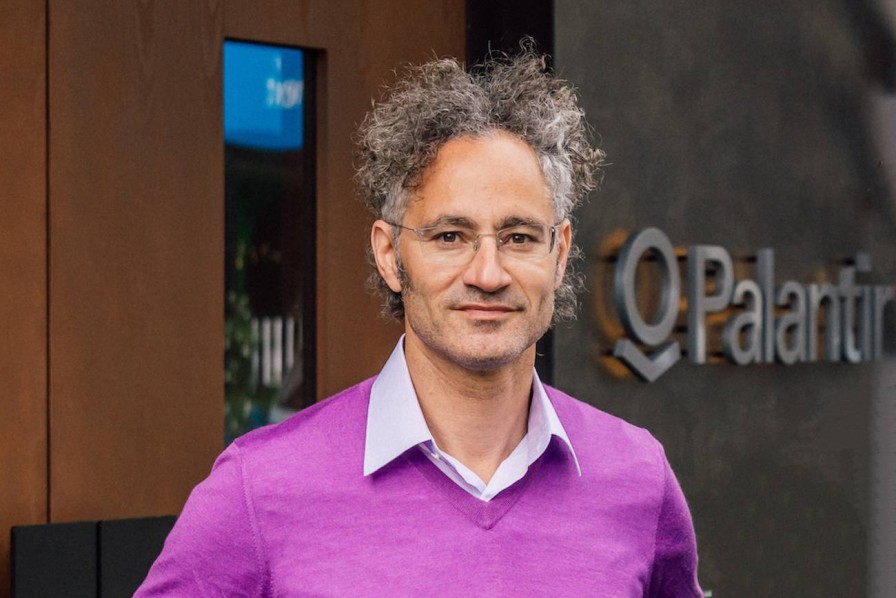
Alex Karp refused to do business with Russia or China.
Given its controversial associations and niche appeal, Palantir wasn't a darling on Wall Street when it went public in 2020 with a direct listing. It turned Karp into a billionaire and enabled him to buy a top-of-the-line Global 7500 business jet. But apart from luxury travel, his lifestyle is abstemious and does not have the distractions of a family or politics.
Just last week, the Wall Street Journal reported he paid US$120 million for a ranch near Aspen, Colorado, that used to be a Trappist monastery. Steinberger describes other remote properties in Alaska and New Hampshire where Karp resides with a small staff comprising Norwegian cross-country skiers for his fitness programme and German-speaking bodyguards.

Alex Karp’s latest property purchase, a former monastery near Aspen.
Net worth
The Bloomberg Billionaires Index estimates Karp's net worth at about US$18 billion. Since Steinberger closed off his book with an interview on July 4, 2025, Palantir has reported its largest quarterly revenue of US$1.4b, making it the highest-valued company at US$350b in the S&P500 on the lowest sales.
It’s a far cry from days in 2022 when Palantir's lack of profitability was lampooned by CNBC Squawk Box commentator Jim Cramer as a “sell above $10 stock” and a “big joke” that he was “not in on”. Like the rest of Wall Street, Cramer has changed his tune as Palantir has soared on the global tensions since the election of Trump 2.0.
“We have lots of debates internally about what we should do; how we should do it,” Karp said in an earnings call on February 2. “But from the beginning, we have stuck to our very strong values of expanding what we believe is the noble side of the West.”
Karp and Steinberger still don’t agree on much, such as Karp’s views on DEI (diversity, equity, and inclusion) from his perspective as “mostly Jewish with a tan”. He refuses to claim benefits as a descendant of slaves.
Steinberger quotes Thiel’s opinion that Karp, given a choice of walking through the front door or trying to squeeze down a chimney, will always opt for the chimney.
Although the metaphor isn’t Thiel’s, it sums up Karp’s complicated world, which he elaborates in his own recent book, The Technological Republic, co-authored with Palantir’s legal adviser Nicholas Zamiska.
It argues that Silicon Valley has detached itself and is hostile to the needs of government and society. It also contends the West lacks the meaning and purpose to enable it to survive in an era of lethal international competition.
Karp and Thiel, who has invoked the Antichrist in recent lectures, are modern-day Horsemen of the Apocalypse. Their fixation on the end of times is deadly serious compared with fluffy concerns about access to social media and the impact of artificial intelligence.
The Philosopher in the Valley: Alex Karp, Palantir, and the rise of the surveillance society (Avid Reader Press/Simon & Schuster).
Nevil Gibson is a former editor-at-large for NBR. He has contributed film and book reviews to various publications.
This is supplied content and not commissioned or paid for by NBR.




