© All content copyright NBR. Do not reproduce, even if you have a paid subscription.
In 2014, four students from Otorohanga College petitioned Parliament for New Zealand history to be taught in schools. This was after they made a class visit to Rangiowhia, one of the significant battle sites in the invasion of Waikato.
Five years later, the Labour-New Zealand First Government agreed New Zealand history should be part of the core curriculum for years 1-9 students (aged between five and 14). Unfortunately, the project appears to be captured by a de-colonialist ideology.
In 2022, the proposed content largely ignored the contribution of British settler colonialists and emphasised Māori history as the “foundational and continuous” narrative.
A change in government in 2025 brought pushback, and the curriculum was rewritten after the protests from mainstream historians, who pointed to the lack of balance and an agenda that, for example, denied an orthodox interpretation of the Treaty of Waitangi.
The revised curriculum now puts New Zealand history into the broader context of the social sciences, including world civilisations, economics, civics, and geography. The further good news is that recent publications have produced a rich supply of sources that make narrow, one-sided perspectives impossible.
Academic historians Michael Belgrave (Becoming Aotearoa) and Erik Olssen (The Origins of an Experimental Society, the first of a trilogy) have incorporated recent research into general overviews. Others include Jared Davidson (Blood and Dirt on prison labour), Vincent O’Malley (The New Zealand Wars | Ngā Pakanga o Aotearoa New Zealand Wars and early encounters), Ned Fletcher (The English Text of the Treaty of Waitangi), and Paul Moon (Colonising New Zealand). Recent official histories of the foreign service, the secret police, and the armed forces are dense with detail.
Oddly, Bridget Williams Books (BWB) has led the way with many of these scholarly books rather than the university-linked publishers. The latest is Garrison World, which at 500-plus pages and weighing 1.85kg, falls short of Fletcher’s 700-plus Treaty opus but is much heavier. BWB has also reissued Atholl Anderson’s The Welcome of Strangers: A History of Southern Maori, while Olssen’s Origins from Auckland University Press is punching at more than 500 pages.

Professor Emerita Charlotte Macdonald.
Previous work
Garrison World: Redcoat Soldiers in New Zealand and across the British Empire, is a career best for Victoria University Professor Emerita Charlotte Macdonald, whose previous work includes monograph-length studies of single women’s migration (A Woman of Good Character, 1990) and the national fitness programmes of the 1930s and early 1940s (Strong, Beautiful and Modern, 2011).
These take a non-insular approach that puts New Zealand’s colonial experience into a world context, as well as bringing social perspectives into areas such as military activity. Garrison World began as a research exercise: Soldiers of Empire, a database of more than 12,000 men who served in the British regiments in New Zealand in the 1860s.
This has required a lot of historical research by others, which Macdonald acknowledges generously, and brings plenty of colour to a book that might otherwise be trapped in the morass of manoeuvrings and logistics that fill many military histories.
Macdonald focuses on three decades in the middle of the 19th century when New Zealand became part of the British Empire. “Capitalism, Christian belief, political ambition and cultural confidence were all drivers of empire, but its most ordered and human presence was that manifest in the army’s redcoat soldiers and the bluejacket sailors of the Royal Navy,” she says.
The period starts with the signing of the Treaty of Waitangi in 1840 and ends in 1870 with the withdrawal of the last imperial forces. London ordered this retreat as it considered the commitment had become too expensive. It was considered time for the colonial authorities to pay for their own defence needs.
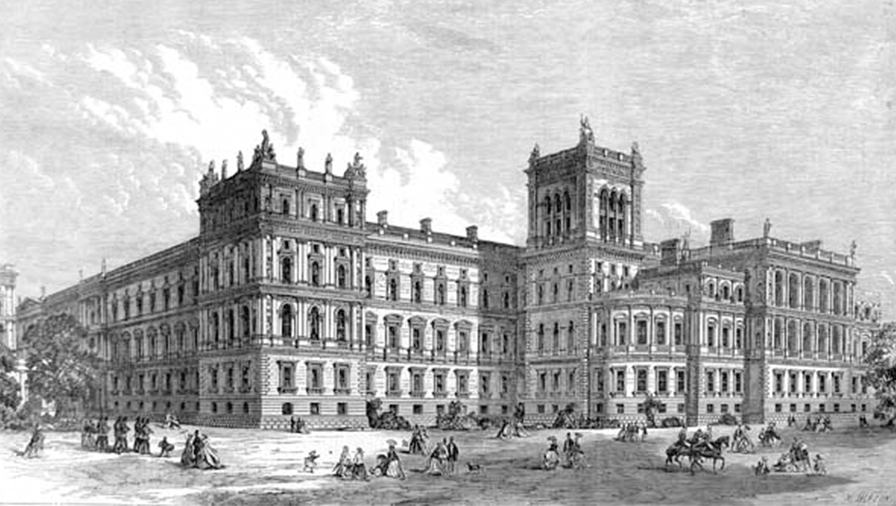
The Foreign, India, Home, and Colonial Offices in London, 1866. Source: London Illustrated News.
Hard line
This coincided with the election of William Gladstone’s Liberals in 1869 and a hard line against the costs of empire from Earl Granville, secretary of state for the colonies. A few years earlier, Secretary of War George Robinson, the 3rd Earl de Grey, had written to Colonial Secretary Edward Cardwell about why such a large military force of 15,000 to 20,000 was required in New Zealand.
In a much-quoted sentence, Robinson wrote: “The cost of such a system is altogether out of proportion to the result to be obtained.” As Macdonald explains, Britain had moved from a “fiscal-military state” – in which the main drag on Treasury funds was an army and navy – to a laissez-faire model.
The main substance of Garrison World is a description of how the fiscal-military state ran its colonies and the legacy it left behind. Some of it was physical – in New Zealand there were more than 200 fortifications, comprising redoubts, stockades, and blockades. In the North Island, where most of imperial forces were based, the colony was ruled by what Macdonald calls a “fortress mentality” and an “architecture of fear”.
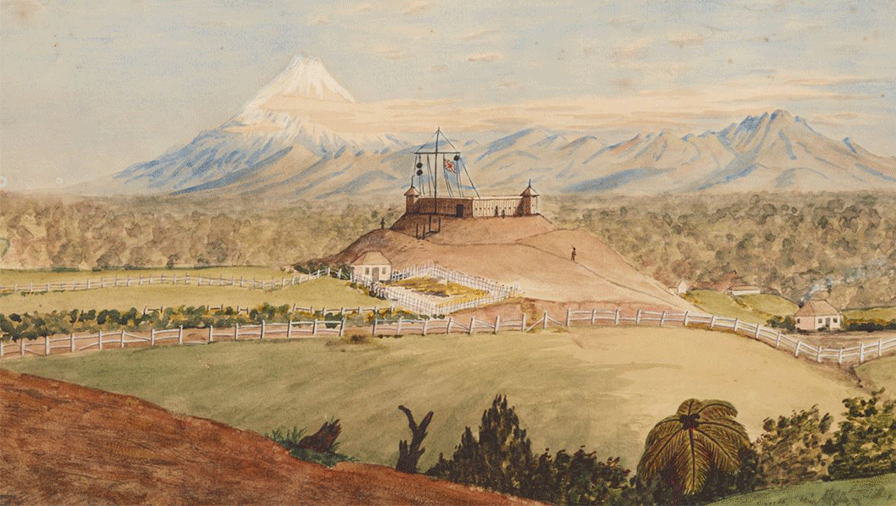
Henry Rawson’s watercolour of the Omata stockade in New Plymouth, 1864.
Opposing principles
Wherever they were built, garrison towns – such as Auckland, Tauranga, New Plymouth, and Whanganui – represented the opposite principles of the settlers they protected. At worst, soldiers who served as convict guards were part of a system of coercion that was an anathema to free citizens: manacles, iron chains, gangs of labourers.
“A system of colonial governance reliant on bayonets and redcoats, chain and whip carried the stench of economic and moral failure,” Macdonald says. New Zealand did not see itself as part of this world, yet the garrison experience was felt most strongly in Auckland.
The colonial governors were all military officers up to the establishment of the provincial government system under the 1862 Constitution. But, in 1853, the first democratic vote in Auckland for provincial superintendent elected Colonel Robert Wynyard over a successful merchant. Wynyard had commanded the forces in New Zealand since 1851.
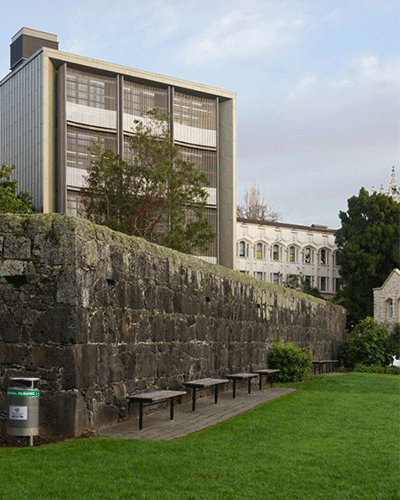
Remnants of Albert Barracks wall, at Auckland University.
Photo: Haruhiko Sameshima
Heavily influenced
That vote was heavily influenced by the ‘Fencibles’, retired soldiers who remained in the colony rather return home to Britain or Ireland. The tension between military and civilian life in Auckland remained until the double whammy of losing its capital status and the withdrawal of troops in 1865/66.
On the positive side, the officer class and other ranks added pomp and pageantry to Auckland’s social, cultural, and sporting life, as well as a thriving economy supplying grog and food. Less welcome was the soldiers’ and sailors’ patronage of brothels and hotels, leading to widespread drunkenness, venereal disease, and crime.
Back in the home country, the tide had turned against the costs of running an empire. The leading political philosopher of the time, John Stuart Mill, had been an active reformer in the 1830s and 1840s as the empire expanded into countries with native populations.
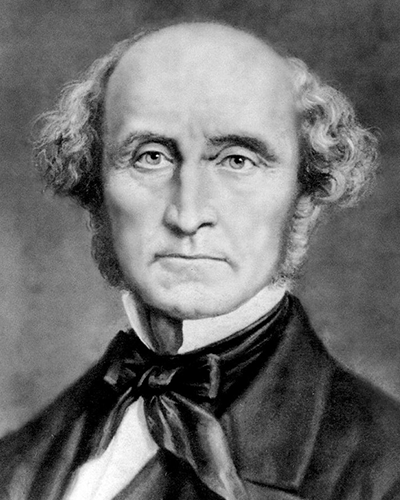
British political philosopher John Stuart Mill.
But, as an elected member of parliament in a Liberal government two decades later, Mill had major reservations about the impact of colonial settlers and the fate of the peoples they ruled.
In 1866, he expressed his doubts in correspondence with his close friend, Judge Henry Chapman, who had emigrated to Dunedin. “[I]s it possible for England to maintain an authority there [in New Zealand] for the purpose of preventing unjust treatment of the Maoris, and at the same time allow self government to the British colonists in every other respect?”
This was written after two major crises in the empire – the Indian Mutiny of 1857 and an uprising at Morant Bay in Jamaica – as well as three decades of conflict over much of the North Island.
“It was not the behaviour of the aboriginal peoples that had proven the problem, [Mill] reflected, but the behaviour of Britons living ‘under new conditions’ in the territories they now claimed as their own,” Macdonald says. Mill felt that, if this problem wasn’t solved, “the country would be divided between two races always hostile in mind, if not always in actual warfare”.
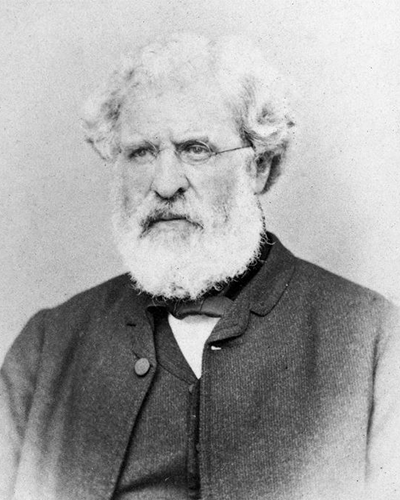
Judge Henry Chapman.
Death toll
While hundreds of thousands were killed as imperial forces suppressed insurrections in India, and hundreds in the Jamaican rebellion, the death toll from the New Zealand Wars was measured in the thousands. Māori were the biggest losers with 2300 fatalities against 700 British from 1843 to 1872, as well as losing millions of acres of land in confiscations.
The biggest single loss among the imperial forces was 180 drowned in the sinking of HMS Orpheus in Manukau Harbour on February 7, 1863.
Māori also lost their demographic advantage. The settler population doubled between 1871 and 1881 to just under half a million. Māori numbers, by contrast, had slumped to 42,000 in the 1890s. Non-Māori births among settlers exceeded the number of immigrants for the first time in 1886, a baby boom that was far greater proportionally than in Britain.
Macdonald divides her epic story into five parts, the first three being an account of the 30 years of wars in New Zealand. The narrative then widens to include conflicts elsewhere, such as the Cape and South Africa, Ireland, and the American Civil War as well as the already mentioned India and Jamaica.
Finally, the fifth part winds up the legacy of the New Zealand experience, touching on the creation of the Armed Constabulary, the failure of military land settlement schemes, and the colony’s rapid population growth and infrastructure development. The 400 pages of illustrations and text are supplemented by 100 pages of notes, sources, and an index, making this volume a shoo-in for the next round of book awards.
Garrison World: Redcoat Soldiers in New Zealand and across the British Empire, by Charlotte Macdonald (Bridget Williams Books).
Nevil Gibson is a former Editor at Large of NBR.




