Reporting conflict is fraught with difficulties that are both historic and as modern as the latest technology.
The head of Le Monde’s international desk, Stephanie Le Bars, recently described how the media are locked out of major world hotspots: Iran, Gaza, Russia, Venezuela, and Mali. To that list you can add China, North Korea, Afghanistan, Cuba, Myanmar, and many others that discourage any intrusion by foreign media.
In Iran, most forms of communication, including the internet and telephone, were cut off or restricted from February 28. This followed a similar blackout several weeks earlier when the Islamic regime killed unknown thousands of young demonstrators.
Israel has enforced a ban on foreign correspondents in Gaza since the October 7, 2023, terrorist attack by Hamas, while Venezuela imposed a brief ban after the abduction of President Nicolas Maduro.
Mali and other formerly French colonies in Africa run by military juntas have become what an Amnesty International official called an “information gulag”. Russia, of course, has been in the spotlight since it launched the “special military operation” against Ukraine in February 2022.
Le Bars reports that Russia has cut internet access and blocked the Telegram channel, “once a rare window to the outside world”. YouTube viewers are kept informed of Russia’s distortions in Steve Rosenberg’s daily translations for the BBC.
In her conclusion, Le Bars says: “Despite the constant flood of video and audio on our screens, the world and our understanding of its events are increasingly hidden from outside witnesses, from journalists and international organisations. These new forms of censorship leave the field open for propagandists of all stripes.
“The new possibilities … of satellite imagery – allowing journalists to work, literally, ‘from above’ – will never replace on-the-ground reporting. The global media landscape is rapidly shrinking. Yet the anxiety-inducing chaos of current events demands more truth and transparency.”
Her concerns are echoed by Alan Philps, a foreign correspondent since 1979 when he was a Reuters trainee in Moscow. His subsequent career took him to London’s Daily Telegraph, where he was foreign editor, and Chatham House, as editor of its magazine The World Today.
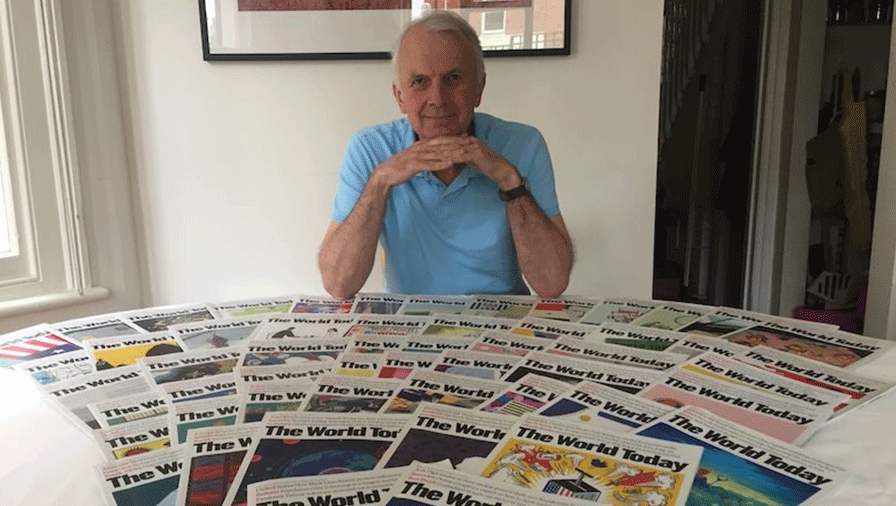
Alan Philps.
New life
He co-authored The Boy from Baby House 10 (2009) with John Lahutsky, a cerebral palsy victim who was abandoned by his Russian mother. Philps’s wife Sarah heard of his plight and helped give him a new life in the United States, where he became honoured by Boy Scouts of America.
The Red Hotel: The Untold Story of Stalin’s Disinformation War is a 430-page account of the “gilded cage” in Moscow occupied by foreign correspondents from the world’s major English-speaking newspapers and radio services from 1941 to the onset of the Cold War.
Like Lise Doucet’s choice of Kabul’s Inter-Continental hotel to tell the story of modern Afghanistan, Philps uses the Metropol Hotel as the lens to view the media’s role in the Soviet Union. Philps first stayed at the Metropol as a 15-year-old schoolboy visiting with his Russophile mother.
His fluent Russian took him back a few years later as a journalist. But it was not until his transfer to North Africa that he met Tanya Matthews, the Russia-born widow of British journalist Ronald Matthews. She worked for the BBC in Tunis and regaled him stories of life at the Metropol during World War II.
She was one of the female Soviet secretary-translators who were the “eyes and the ears of the visiting journalists” and the real heroes of this book, according to Philps, as they risked much more when not following the party line.
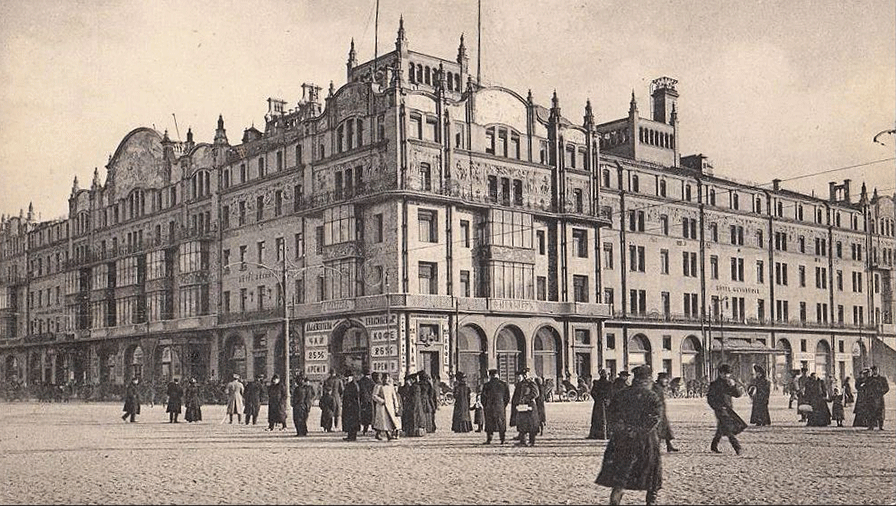
The newly opened Metropol Hotel in Moscow, 1905. Source: Wikimedia Commons.
‘Shining example’
The Metropol opened in 1905 as a “shining example of the Art Nouveau style ... with highly coloured elements of décor drawn from Russian folklore”. Its former glory had long faded by 1941, when Hitler ripped up the Nazi-Soviet pact and launched an invasion.
Stalin bowed to pressure from British Prime Minister Winston Churchill, a former war correspondent and keen to have battle-front news as the Soviet Union joined the war against Nazi Germany.
However, Stalin had other ideas. He ensured the foreign media had plenty to eat and drink at a time when ordinary Russians lived on scarce rations. The secretary-translators chose stories from the Russian papers and sent the correspondents’ versions to the censors before transmission to the outside world.
After a clamour to see some action, a group were finally taken to the front near Smolensk, which had just fallen to the Germans. Banquets and vodka drinking contests were held on each of the six nights.
The journalists witnessed a shot-down German Junkers-88 and interviewed the pilot. They also visited a town where the Germans had been driven back. They reported the possibility of a Soviet counterattack, thus fulfilling Stalin’s aim of generating support from the Allies for more aircraft, ammunition, and other supplies.
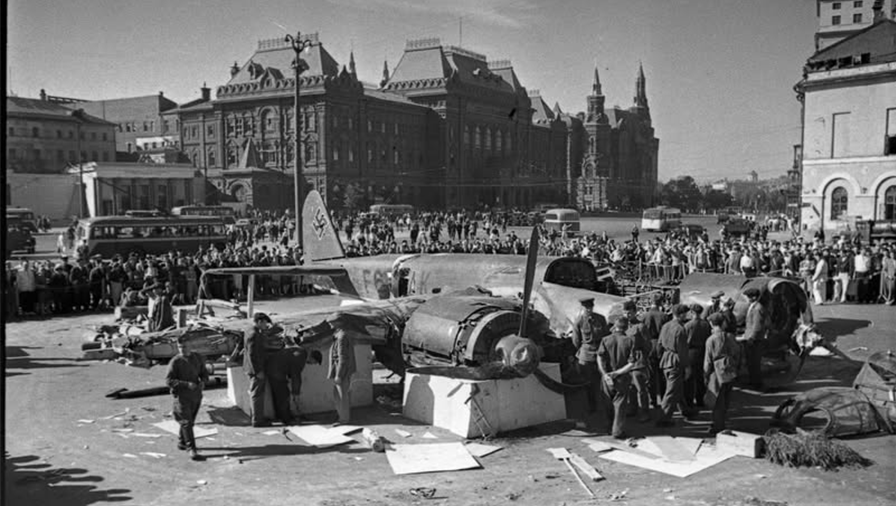
A downed Junkers 88 on display in Moscow’s Sverdlov Square, 1941.
Advance resumed
The Germans soon resumed their advance, forcing a mass evacuation of Moscow’s population to Kuibyshev on the Volga River, a 1120km, five-day train trip. The press corps was depleted In December 1941 as some Americans left after Pearl Harbour to focus on the war in the Pacific.
Working conditions for those remaining did not improve. They could not interview Russian citizens or write eyewitness reports on the major events, such as the 872-day siege of Leningrad that lasted until January 1944.
Those stories came from Red Star, the army’s newspaper, and its most noted writer, Vasily Grossman. Some of the Metropol’s guests returned home after a year or so and wrote memoirs that hinted at the communist system’s shortcomings.
These included Communist Party sympathisers and members such as Charlotte Haldane, wife of the scientist JBS Haldane. Australian Godfrey Blunden, among the best of the Moscow correspondents, scored some major scoops, including the Nazi massacre of Jews at Kharkov and the 200-day Battle of Stalingrad that turned the tide of the war in 1942.
He later fictionalised his experiences in A Room on the Route (1946), a sensational story that ranks among the best anti-communist novels. It had severe consequences for Blunden’s secretary-translator, Nadya Ulanovskaya, and the woman whose flat overlooked the heavily guarded passage from the Kremlin to the elite’s dachas in the countryside.
Nadya and her husband Alex had been Bolshevik agents since the 1917 revolution and recruited Whittaker Chambers in New York in 1931. He later recanted, as did they, before they spent years in the Gulag camps until their release in the mid-1950s. After emigrating to Israel, Nadya and daughter Maya wrote a remarkable autobiography, translated as The Family Story (1982), though Philps does his own from the Russian original.
Enigmatic spy
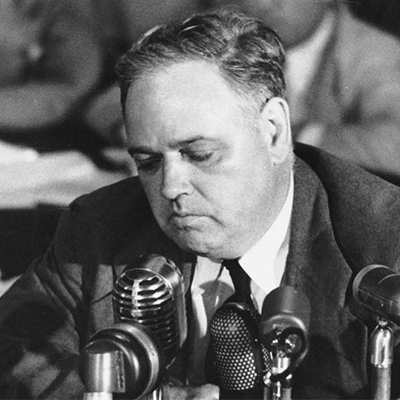
Whittaker Chambers, in 1948 in Congressional hearings.
This was just one of 70-odd books produced by or about the occupants and workers in The Red Hotel. They included Edgar Snow of Red Star Over China fame, Cyrus Sulzberger of the New York Times-owning family, Russian-born historian Alexander Werth, and the enigmatic British spy Ralph Parker, who worked for The Times and was considered the foremost of the Kremlin “stooges”. Valentina, his Russian wife and secretary-translator, like Nadya, was an agent of the NKVD, the Soviet secret police.
Most of these books are well out of print and coloured by attitudes of the time, whether pro-Soviet during World War II or anti in the Cold War. But they all described the common features of a dictatorial system that, as Philps reminds us, has returned in another guise under Vladimir Putin.
Philps quotes a New Republic review in 1943 of four books by Americans about wartime Moscow that all told the same story, except for their descriptions of the beard belonging to British academic A T Cholerton. He was the doyen of the Metropol correspondents, having arrived in 1927 to report for the Daily Telegraph and soon after marrying a Russian.
His knowledge was unmatched and he mentored many subsequent arrivals, such as Charlotte Haldane. He was refused a visa to return after a holiday at home in 1943 despite pleas by the British Government, which valued his expertise, and a personal appeal to Stalin. The NKVD was spared the need to expel him. Instead, it arrested his lover and long-time secretary-translator, Natalia Vodovozova, and sent her to the Gulag for 10 years.
In a conclusion, Philps reveals British ambassador Stafford Cripps had urged editors in London not to send correspondents to Moscow as they could not fulfil Churchill’s desire for objective reporting. This meant the British public, “fed for years on a sanitised image of Stalin, was ill-prepared for the confrontation that set in after the war”.
Further, led to believe Soviet propaganda – that there would be a period of peace and prosperity – they instead faced rearmament for the Cold War and the “huge expense of creating a nuclear deterrent”. That situation is worse today, with Moscow’s few correspondents even facing the prospect of arrest, something Stalin never dared.
The Red Hotel: The Untold Story of Stalin’s Disinformation War by Alan Philps (Headline/Hachette).




