Wall Street continues to dominate the world financial scene despite the Jeremiahs saying the United States is embroiled in another war it cannot win.
Stocks continue to rise and the dealmakers are as busy as ever. In the past week, Anthropic was reported to be partnering with Goldman Sachs and Blackstone to launch a US$1.5 billion ($2.52b) company aimed at speeding the adoption of AI by hundreds of companies. The new entity plans to install Anthropic’s Claude AI model directly inside businesses, starting with companies owned by the investment firms.
GameStop chief executive Ryan Cohen pitched a daring US$55.5b play for e-commerce giant eBay, the company that made Elon Musk’s first fortune on his way to becoming the world’s richest man.
The first definitive history of Wall Street, by Charles Geisst, was published in 1997. It provided a start date of 1790, when a loose association of traders transacted business on the sidewalks and in the coffee houses of New York.
Geisst, a professor of finance at Manhattan College, noted that those traders would still recognise many trading techniques and basic financial instruments. “Fortunately, their philosophies for taking advantage of others have been replaced with investor protections and a bevvy of securities laws designed to keep the poachers out of the henhouse, where they had comfortably resided for almost 150 years,” he says.
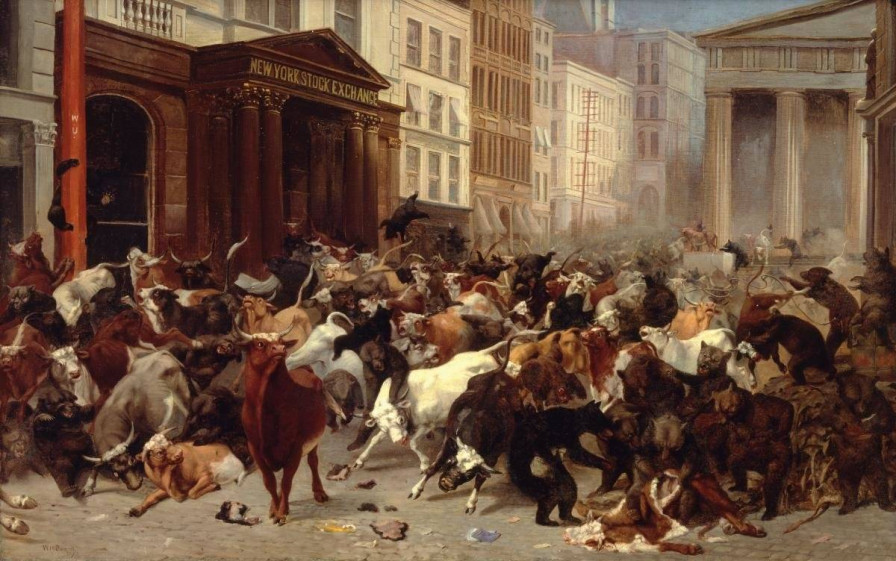
William Beard’s ‘Bulls and Bears in the Market’ (1879) was used on the cover of Charles Geisst’s history of Wall Street. (Source: New York Historical Society.)
That ended in the mid-1930s, at the height of the Great Depression, for which Wall Street was blamed. But Andrew Ross Sorkin’s 1929 tells a different story. The stock market’s collapse did not trigger an economic crash.
That occurred a year later. Stocks had recovered, but the passing of the Smoot-Hawley Tariff Act and a series of bank failures, abetted by federal government policies, sparked the Depression. A second stock collapse in 1931 followed. It was only later that the 1929 crash became conflated in the public mind as the cause.
Neither Geisst’s Wall Street nor Sorkin’s 1929 deal with the activities of Clarence Dillon, one of the best-known investment bankers of the time. Geisst has just one reference: Dillon was listed by Forbes in 1968 as one of the richest people in America.
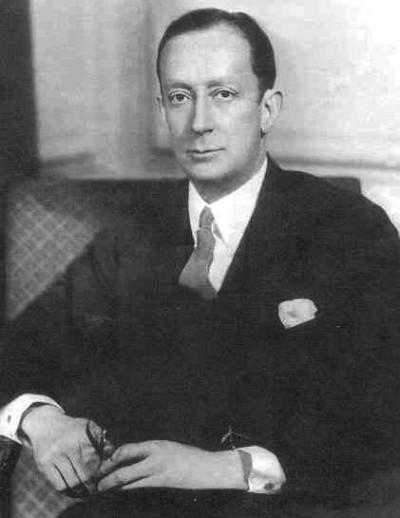
Clarence Dillon in 1942. (Source: Clarence Dillon Society)
Different picture
The Baron of Wall Street, by William Loomis Jr, is a biography dedicated to Dillon and his exploits. It paints a much different picture of Wall Street than other histories. Loomis was a former chief executive of Lazard, an investment bank. His insider’s perspective contrasts with that of an academic or a journalist. However, Loomis does not gild the lily.
He is tough on Dillon’s lack of a moral compass but admiring of his abilities. Loomis had access to an unpublished 100-page autobiography that Dillon, ever conscious of his legacy, had created in his retirement. He lived to 96, keeping good health due to his fitness regime up to his death in 1979.
Loomis found it full of fiction, starting with Dillon’s family background, education, and rise to business prominence after World War I. His father Sam (formerly Schmuel) Lapowski was an immigrant Polish Jew who arrived in Texas in 1869 and built up a successful retail business with his brother Jake. They married sisters, whose parents were from the Pale of Settlement, an area of the Russian Empire reserved for Jews.
Clarence was born in San Antonio in 1882. In 1901, he changed his surname to Dillon, based on his grandmother’s family name of Dylion. He reinvented a Swedish Lutheran background for his mother and worked hard to deny his Yiddish connections when higher education and Wall Street were off limits to Jews.
Dillon attended Harvard, where he excelled in the non-academic activities of the white Anglo-Saxon Protestant (Wasp) elite. His social climbing was completed by marriage to Anne Douglass, an heiress of a rich Milwaukee family, and becoming an Episcopalian.
He was a bond salesman during World War I and took control of William Read’s company in 1921, renaming it Dillion, Read & Co. A rapid ascent followed, using connections forged at the War Industries Board and during negotiations in Europe on post-war reparations.
“Dillon returned to New York in April 1919 with a fierce determination to both challenge the established heavyweights of Wall Street … and to make a name for himself abroad,” Loomis says.
Gilded youth
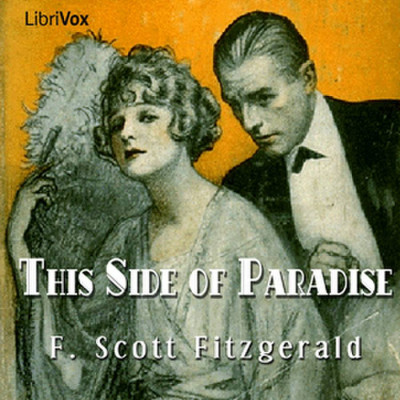
F Scott Fitzgerald’s first novel.
The writer F Scott Fitzgerald, who attended Princeton in 1917, best described the 'gilded youth' who filled the ranks of Wall Street during the Roaring Twenties in This Side of Paradise (1920): “Here was a new generation dedicated more than the last to the fear of poverty and the worship of success.”
Among Dillon’s protégés was James Forrestal, also an ace bond salesman and later the first US Secretary of Defense. The first of Dillon’s major deals was a rescue package for the bankrupt Goodyear Tire and Rubber Company, financed by high-yielding securities – the 'junk bond' era had begun.
It was controversial and led to years of litigation that ended with Dillon ceding control. The Goodyear case was a forerunner for the Chapter 11 bankruptcy structure in 1978.
Dillon’s interest in foreign investment involved Italy, Germany, and most of South America, where Americans pushed out the traditional British financiers. Bonds for electrification, ports, and railways were highly profitable to the issuers, but less so for the investors, who lost heavily.
During his many visits to Europe, Dillon helped finance the German recovery, with a focus on coal and steel, chemicals (IG Farben), and electronics (Siemens). This continued under the Nazis, although Dillon, Read’s Jewish connections became a public issue. The Nazi press identified Dillon as a leader of the “Wall Street Jewish conspiracy”, although he was also described as “second only to Henry Ford as a financial genius”.

The Dodge Motors plant in Detroit after the Chrysler takeover.
In addition to junk bonds and bankruptcy protection, Dillon’s innovations included the use of public relations to burnish his business status, private equity, and leveraged buyouts. This was demonstrated in his US$146 million all-cash bid for Dodge Motors, owned by two brothers who died of alcoholic poisoning.
In 1928, Dodge was the same size as Ford, in an industry where demand for motor vehicles outstripped supply. Wall Street had never seen a cash deal as big as that made with the Dodge widows. But Dillon’s skills at raising cash did not extend to running a large manufacturing enterprise.
The launch of new models, noted more for their hype than reliability, nearly sank the company. Fortunately, rival carmaker Charles Chrysler lacked the capital to keep up with demand for his superior vehicles. Dillon engineered an all-stock merger worth US$170m, earning him a profit of US$48m (US$700m in today’s money).
Two other burgeoning industries caught Dillon’s attention: Hollywood and office technology. The early movie business was dominated by Yiddish immigrants, who moved to California to escape the prejudices of the East Coast.
Dillon bankrolled the biggest of these pioneers, Carl Laemmle's Universal Pictures and Loew’s theatres. Wall Street’s Wasp establishment considered the industry immoral, which Loomis confirms in his raciest chapters about how the money men mixed with beautiful women focused on stardom.
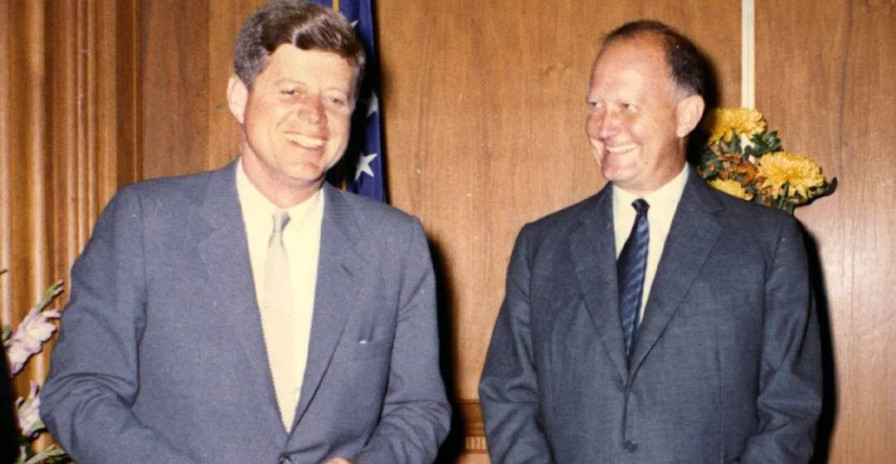
US President John F Kennedy and Treasury Secretary Douglas Dillon. (Source: JFK Library)
Shady business
That shady side of the business wasn’t a concern for Dillon and another outsider, Irish Catholic Joseph P Kennedy. Both entered and quit the industry before the 1930s crash. Kennedy’s exploits with screen goddesses were widely reported, while Dillon maintained a low profile that lasted for the rest of his life. Their sons came together three decades later, with John F Kennedy as President and Douglas Dillon as Secretary of the Treasury.
The novelist Fitzgerald continued to document the Jazz Age in The Great Gatsby (1925), based on the lifestyles of partners who worked at Dillon, Read and other Wall Street firms. They enriched themselves at others’ expense, while underwriting large businesses, such as Dillon’s float of National Cash Registers in 1926, Wall Street’s biggest to date.
In 1934, aged 54, Dillon retreated from public view, leaving his firm in Forrestal’s hands. Wall Street’s wildest days were over, with a raft of laws and regulations that curbed its excesses. Joseph Kennedy was appointed the first head of the Securities and Exchange Commission.
Dillon, meanwhile, remained a power behind the scenes, helping President Franklin Roosevelt with a new tax code and providing him a conduit to new British Prime Minister Winston Churchill at the beginning of World War II.
Loomis provides no sources for his disparaging judgments but does include a rich bibliography. This is a story well worth reading of a period shrouded in myth and its sins forgotten. In financial misbehaviour, nothing is new.
The Baron of Wall Street: Clarence Dillon and the Making of the Modern Financial World, by William R Loomis (Hanover Square Press/HarperCollins).




