© All content copyright NBR. Do not reproduce, even if you have a paid subscription.
Admit it. Donald J Trump’s year is his best yet. He has dominated world headlines like no other leader. He has given a master class in political strategy.
He learnt the hard way from his chaotic first term. Readers may recall some accounts of that period: Bob Woodward’s conscientious trilogy Fear, Rage, and Peril, or Michael Wolff’s fanciful Fire and Fury and Landslide.
The best was I Alone Can Fix It, Trump’s annus horribilis by Washington Post journalists Carol Leonnig and Philip Rucker. My review covered what the authors described as a “catastrophic” year, which ended ingloriously on January 6, 2021, with the storming of the Capitol.
But by the end of October, when that book was released, Trump was rising again in the polls and Joe Biden’s support was dwindling just eight months after his inauguration.
Jumping forward to August last year, I reviewed 2024: How Trump retook the White House and the Democrats lost America, by Josh Dawsey, Tyler Pager and Isaac Arnsdorf, all then reporters with the Washington Post.
First 100 days
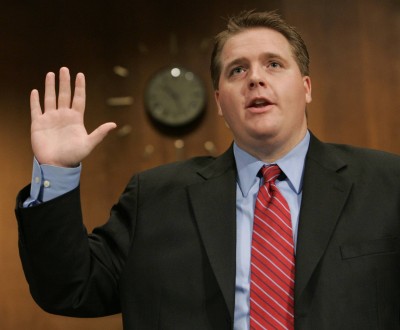
Scott Jennings testifies to a US Senate Judiciary Committee in 2007.
A book-length account of Trump’s first 100 days of his second and final term, A Revolution of Common Sense: How Donald Trump Stormed Washington and Fought For Western Civilisation, doesn’t come from the Washington Post or any other recognised expert.
Instead, Scott Jennings comes from a background of working for the Republicans, notably as a special assistant to President George W Bush in 2005. He had previously served as a staff member of Bush's presidential campaign in Kentucky in 2000 and executive director of Bush's 2004 re-election campaign in New Mexico in 2004.
Jennings was also an adviser to Senator Mitch McConnell's campaigns in 2002, 2008, and 2014. His media profile began to rise in the 2016 presidential campaign as a commentator on the Fox News Channel.
YouTube clips show he has transformed himself from a chubby Seth Rogen lookalike of the Bush years to a slick George Clooney advocate for conservative causes. In 2017, he joined CNN as a token Republican in a 24-hour news channel that is stuffed with Democratic debaters.
Today, he is still a fixture on NewsNight with Abby Phillip, a shouting match panel in which he is pitted against four or five political opponents. This is not an edifying show by New Zealand standards, but it does reveal the entertainment value of differing opinions, something absent in our local media.
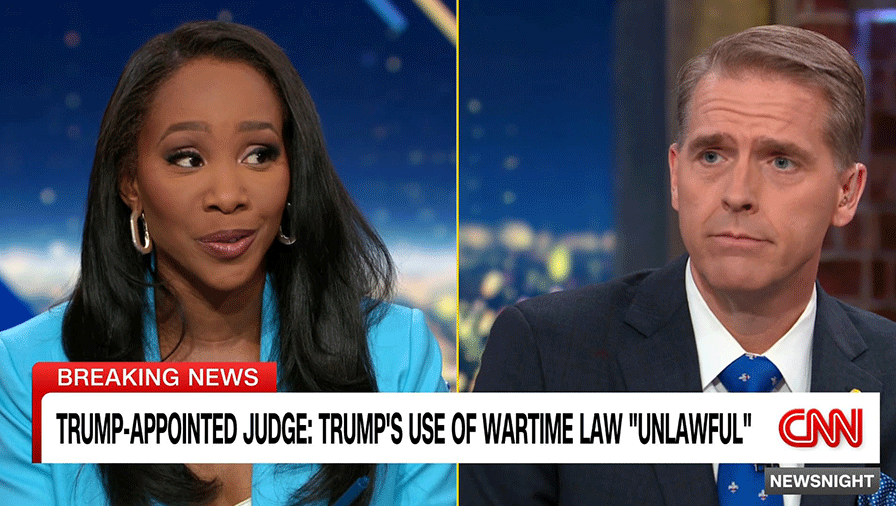
Abby Phillip and Scott Jennings on CNN, May 2, 2025.
Gradual conversion
Early in his political career, Jennings was not a Trumpite Republican. He didn’t serve in Trump’s first term. The conversion was gradual as he observed Trump’s second coming in the Republican Party.
This was no accident but a carefully planned strategy that Trump and his team had honed from their defeat. Jennings did not even meet Trump until February 10 this year, three weeks after the latter had taken office for the second time.
Yet Jennings had already absorbed the reason for Trump’s decisive victory – a champion against policies that undermined or threatened Western civilisation. In electoral terms, this meant working-class Americans, mainly men, who had seen their jobs disappear from the ‘rust belt’ to China. It also included 'trad wives' and homemakers, who feared the effects of gender politics on family values.
Jennings picked up on a phrase Trump had used in his inaugural address: ‘common sense’. The ability to think and say things that were contrary to new cultural terms surrounding race, gender, climate change, and law enforcement.
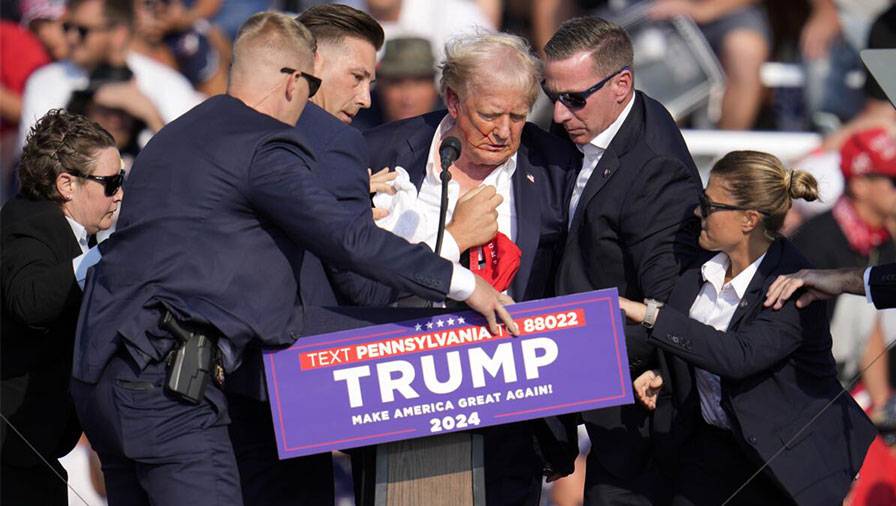
Donald Trump gained a sense of urgency after the assassination attempt in July 2024.
Sense of urgency
Added to that was a sense of urgency – a pivot from the assassination attempt at the Butler rally on July 14, 2024, and knowing there would be no third term. Trump’s team had to fit his management style and hit the ground running. The cabinet has lived up to expectations. Even the falling out with Elon Musk was not permanent.
America changed overnight when Trump signed 196 executive orders – legal or otherwise – on his first day. All were campaign promises and had been implemented immediately. The tsunami of change continued, ranging from measures that overturned Biden Administration policies to banning men from competing in women’s sports.
Jennings tracks the big-picture items of border control and immigration restrictions; deporting illegal overstayers; restoration of cheap energy based on fossil fuel; scrapping employment and education quotas; using tariffs for leverage in trade deals; reducing taxes and regulation; and eliminating government waste, including overseas aid programmes.
All were part of a bonfire package of so-called progressive policies that, Jennings claims, were not supported by most of the population. Control of borders – both against illegal immigrants and shipments of substances such as fentanyl – was an early and popular measure.

An official report in March 2025 estimated there were 18.6 million illegal aliens in the US.
Not enforced
According to Jennings, the legislation already existed but had not been enforced under Biden. During his term, a record 10.8 million “encounters” were recorded with illegal immigrants from 2021 to 2024. By March 2025, just weeks after Trump took office and started enforcing the legislation, 7181 were stopped compared with a previous monthly average of 150,000.
The abolition of DEI (diversity, equity, inclusion) policies was just as popular, particularly among voters of Asian descent, whose bright children were excluded from universities. “[DEI] is a system of law that has grown so big we can barely see it any more,” Jennings says, quoting a commentator who described its repeal as “the most consequential policy decision of the 21st century”.
DEI’s close relatives, ESG (environmental, social, and governance) investing and the Corporate Equality Index, were also despatched without ceremony. “What began as a bureaucratic nudge in the 1960s had … become something more coercive … [reaching] every corner of American life – hiring, education healthcare, even aviation,” Jennings says.
The priority of DEI over safety became an issue, with a drop in Boeing’s manufacturing standards that led to a door panel blowout and an air traffic failure causing a fatal crash at Reagan National Airport in early 2024.
Trump’s self-proclaimed ‘Liberation Day’ – the launch of a tariff-based international trade programme – produces the biggest challenge for Jennings. He admits it overturns Republican orthodoxy and is by far the most radical of all Trump’s policies.
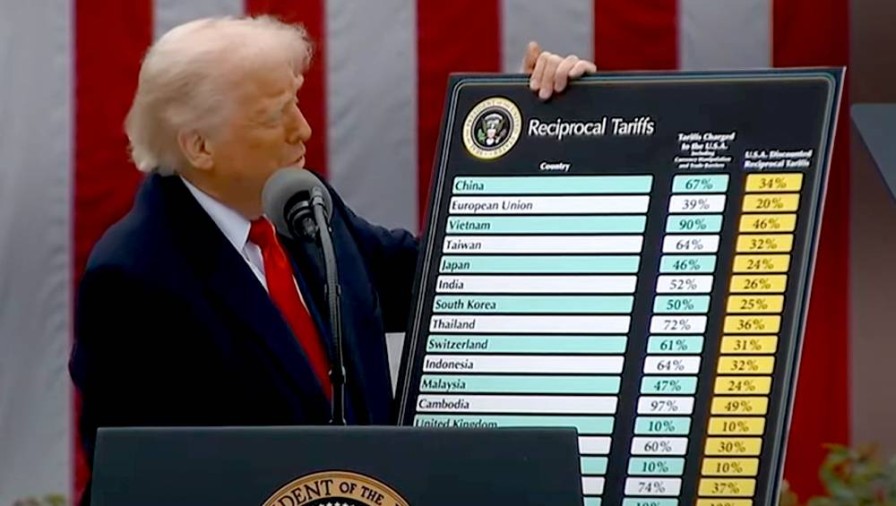
President Trump’s tariff policies have defied economists’ fears.
No global crash
Economists hate them – see this review of Philip Coggan’s The Economic Consequences of Mr Trump – but, so far, they haven’t caused a global crash. Employment has continued to rise, inflation is contained, and financial markets are soaring.
The US Government has made billions in tariff revenue, and major Western economies have responded with pledges of “reshoring” industries back to America. These include South Korea’s US$350 billion investment, with nearly half of it going to a rebuild of American shipbuilding capability. Japan has done likewise in advanced technologies.
In book promotion interviews with Sage Steele and Erick Stakelbeck, Jennings has explained that Trump is determined to stay ahead of China in the AI stakes, as well as restore America’s industrial might based on cheap energy. This is not an isolationist America, but one aspiring to unchallenged world leadership.
Trump displayed this to a succession of White House visitors, whose encounters range from the dressings down for Ukraine’s President Volodymyr Zelensky and South Africa’s President Cyril Ramaphosa, and praise for warring African and Asian leaders who have signed peace treaties.
While Jennings gives full attention to some of Trump’s foreign policy triumphs – such as US involvement in the 12-Day War that pulverised Iran’s nuclear bomb hopes – he ignores Gaza, where a positive outcome is less certain.
The book’s cutoff leaves the Ukraine strategy in doubt. I get the impression Trump sees Russia as a natural member of the Western club and its civilisation rather than a rival power espousing the anti-American views of China or even India.
Fans of Trump, who are constantly bombarded with oppositional media coverage, will welcome his defence by someone who is a close and reliable source. Critics should find enough material to raise doubts about writing off a leader who has outperformed all others on the world stage this year.
A Revolution of Common Sense: How Donald Trump Stormed Washington and Fought For Western Civilisation, by Scott Jennings (William Morrow/HarperCollins).
Nevil Gibson is a former editor at large for NBR.




