A promising debate on how two National finance ministers viewed their management of the economy fizzled out at the end of last year.
But the core issue remains: the continuing rise in public debt because governments cannot live within their means. The jargon calls this a “structural deficit” – not a temporary shortfall that occurs on a cyclical basis, but a permanent one.
If not tackled by producing a surplus in good years or by using some shock therapy, it remains an economic burden that affects growth possibilities. The 'pain and gain' evidence of the 1990s was evidence that the approach of Sir Roger Douglas and Dame Ruth Richardson worked a treat.
But MMP changed the dynamics, mainly for the worse. No one votes for austerity and sound fiscal policies. With few exceptions, parties need bribes to win votes.
The tripartite coalition in power has one participant that is more dependent on such bribes, though it does favour spending cuts in other areas that don’t affect its voters.
Kiwiblog’s David Farrar recently produced a good analysis that recognised the limitations placed on finance ministers while urging that the debt problem won’t go away.
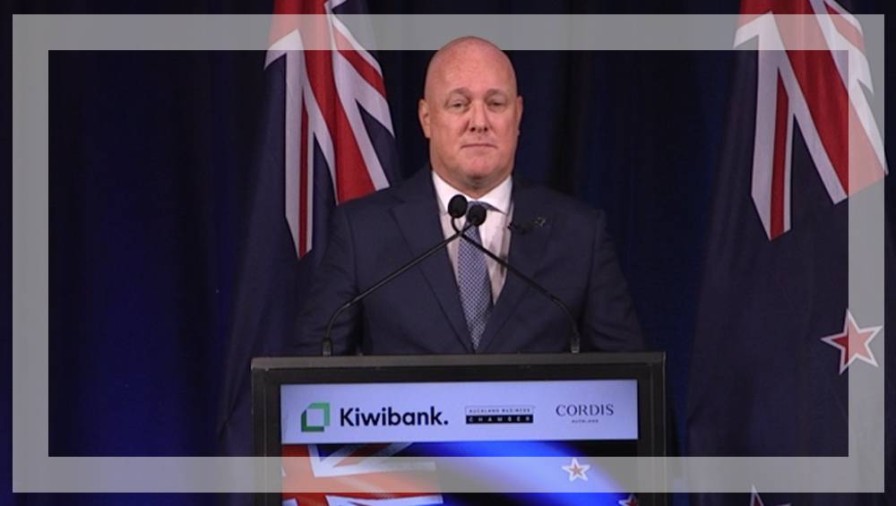
Christopher Luxon delivering his State of the Nation speech last week.
Subdued speech
It was, of course, ignored in Prime Minister Christopher Luxon’s subdued State of the Nation speech in the past week. But at least Luxon aimed to reduce expectations and persuade more voters that ‘steady as she goes’ – low inflation and interest rates – would keep the debt issue at bay.
It might mean Labour and other critics of the incumbent parties will have less opportunity to gain support for an expansive (and expensive) change from a new coalition in power.
One dissenting voice hoping for a seat in a new Parliament is Craig Renney, a trade union economist and Labour candidate for Wellington Bays, a constituency now known as Rongotai, and held by Green MP Julie Anne Genter.
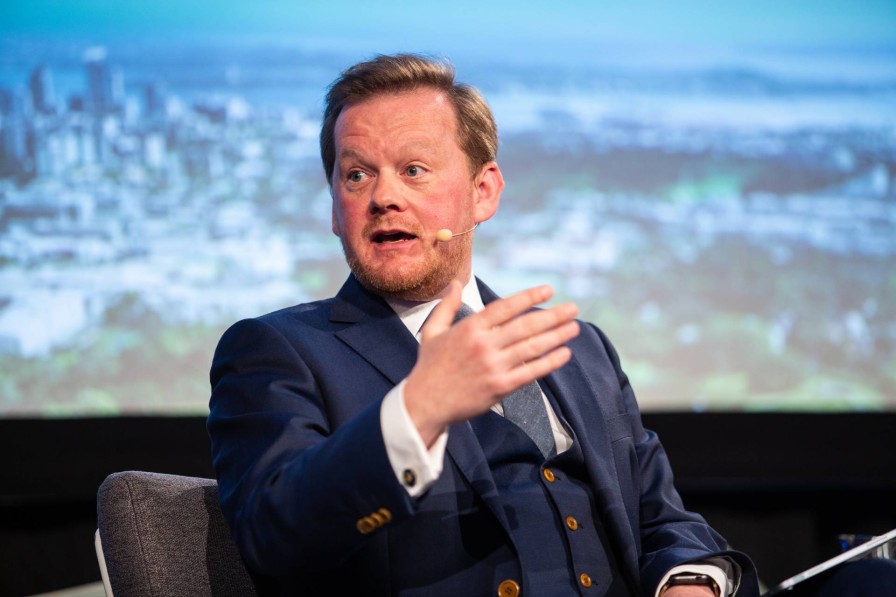
Economist Craig Renney.
Renney brings substantial clout to an economic debate – but hopefully not enough that it is likely to send New Zealand into a socialist direction. He was recruited by the Treasury in 2012 from northern England. His socialism was honed as a coalminer’s son and therefore a victim of Thatcherism.
He was only five or six years old during the 1984 miners’ strike. I was also in England at the time, reaching different conclusions about what was good for that country and the role of unions.
Far-reaching reports
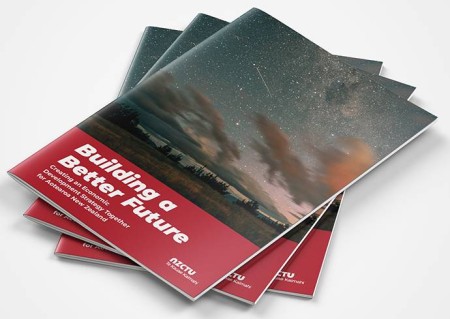
After a decade in the public service and advising Labour governments (2017-23), Renney switched to the Council of Trade Unions, where he produced the far-reaching Building a Better Future reports with Diana Russell. These did not make much of an impact at the time (2022), but the main concepts have not been forgotten.
They have been updated and expanded in The Good Economy, the latest in the BWB Texts series. For a non-believer in socialism, the presentation resembles the YouTube AI-generated mashups of ‘Why is Everybody Leaving New Zealand?’ and ‘Why New Zealand is Going Broke’.

A wide range of statistics is used to reach dubious conclusions by ignoring counter-arguments. When it comes to solutions, these invariably mean raising and spending more money by governments to reduce inequality, boost incomes and provide free public services.
Building a Better Future outlined proposals for higher taxation (mainly on capital income and wealth), a national investment bank for major projects, and a climate-change-focused Ministry of Green Works, which would create more housing and train a skilled workforce.
The energy sector would come under complete government control to ensure a transition away from fossil fuels to 'green' electricity and hydrogen. Wages and employment conditions would be subject to a Decent Work Act that would reduce unemployment, the gender pay gap and accidents.
An Inflation and Incomes Act would tackle issues associated with the cost-of-living crisis, creating higher incomes, raising productivity, and limiting dependence on economic levers such as the Reserve Bank’s official cash rate.
Policies reversed
A four-day working week, and improvements in health and education, were all outlined in detail. Some of these policies were picked up by the Labour Government elected in the 2020 Covid-19 election. But delivery was haphazard and several were reversed after the 2023 election.
The Good Economy adds substantially to the above list with chapters on child poverty, housing as a human right, and making higher education less of a financial burden. Proposals include nationalisation of electricity generation, as well as windfall taxes on banks and supermarkets.
As it is difficult to dispute the many facts and figures that Renney uses to bolster his case for change, I propose to critique a few of the issues mentioned from the angle that greater state control is not the answer.
Child poverty: This is conventionally viewed as a circular process with stressed low-income parents unable to make good decisions for their children, who in turn inflict this failure on their own offspring.
But this theory doesn’t explain the experience of immigrant and refugee families, who know the value of education and are culturally attuned to aspiration regardless of their low-income status. Rather than redistribute income through welfare, the focus should be on improved parenting skills.
Minimum wage: Renney urges substantial increases in the minimum wage, a policy popular with all governments. He observes that if the minimum wage was raised to the level of the living wage for the year to April 2026, it would boost incomes by 18% or $8944, as well as generate extra tax revenue of $185 million to pay for more teachers, nurses, etc. He further states the minimum wage of $48,880 would be more than $50,000 if it were inflation-adjusted.
Recent research has thrown doubt on the belief that such increases have no impact on employment levels. Low-skilled workers’ hours were reduced substantially after hourly rates in Seattle reached US$13 an hour (half that of New Zealand’s). Other studies showed an increase in injury accidents and increased grocery prices.
The Economist (November 11, 2025) weighed in on the change in the scholarly tide, and concluded “minimum wages are a relatively wasteful way to redistribute cash” as many low-paid, entry-level workers live in middle-class households.
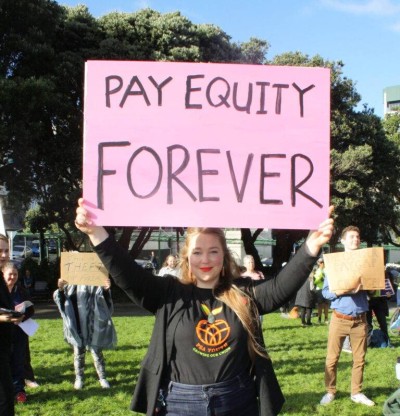
Pay equity protest. Source: Kaiitiaki Nursing New Zealand
Gender pay equity: The coalition Government claimed a $12 billion saving from a change in the rules of establishing pay equity between jobs dominated by women and those by men. Most of these claims were in the public sector, where the extra costs could be added to the tax bill on the whim of a court decision rather than an employer’s calculation of worth.
As one commentator (Farrar again) put it: “The 2020 regime was less about ‘fairness’ than about forcing state-backed pay outcomes through an arbitrary and coercive framework”.
Incidentally, Renney goes further with a suggestion that parental pay should provide extra benefits such as KiwiSaver contributions by adding it to another of Labour’s axed schemes, income insurance funded by levies.
Wealth and equality: A new history of wealth in the West, Daniel Waldenström’s Richer and More Equality, takes issue with the common refrain that the rich are getting richer and the poor poorer. Western societies have never been as wealthy or more equal in their distribution.
Their nature has also changed. A century ago, wealth was concentrated in agricultural and business assets owned by a small elite. Today, all classes have access to housing and pension savings or benefits.
The richest individuals are entrepreneurs, who have built their own businesses rather than inherited them. Waldenström argues, “it is primarily economic growth and financial development and, importantly, the inclusive political and economic reforms of the 20th century, that have made us both richer and more equal today than in the past”.
This is an all-ships-rise-in-the-tide way of looking at the economy, rather than the zero-sum approach that says someone’s success comes at someone else’s expense. Incidentally, Waldenström and Renney agree on one thing: a tax on capital income (profits and dividends) is fair; but Waldenström opposes a wealth tax on grounds that a “good economy” is one where home ownership and long-term savings are the best means to create wealth and economic equality.
The Good Economy: What does a good economy look like and how do we build it? By Craig Renney (BWB Texts).
Nevil Gibson is a former editor-at-large for NBR.




