It’s 250 years since the founding document of modern capitalism, Adam Smith’s The Wealth of Nations, was published in 1776. Yet public acceptance of its core principles – free-market competition and profit – remains elusive.
A recent study that divides New Zealand voters into five tribes illustrates the reason. The biggest group is Middle New Zealand, but they are outweighed in political influence by two other tribes.
The Educated Progressives have doubled in number between 1990 and 2023. They have overtaken the once politically dominant tribe, known as the Establishment Right, and reject any form of capitalism.
They do not exert their influence through ownership of productive land or businesses. Instead, their power is exercised through the public sector, including the judicial, education, and health systems, and many non-government organisations as well as the media. It is here that ignorance of capitalistic rules is at its most extreme.
This rise in political power has been accompanied by new set of ideas that contradict Smith’s faith in competition as the driving force for economic growth through innovation, invention and human self-interest.
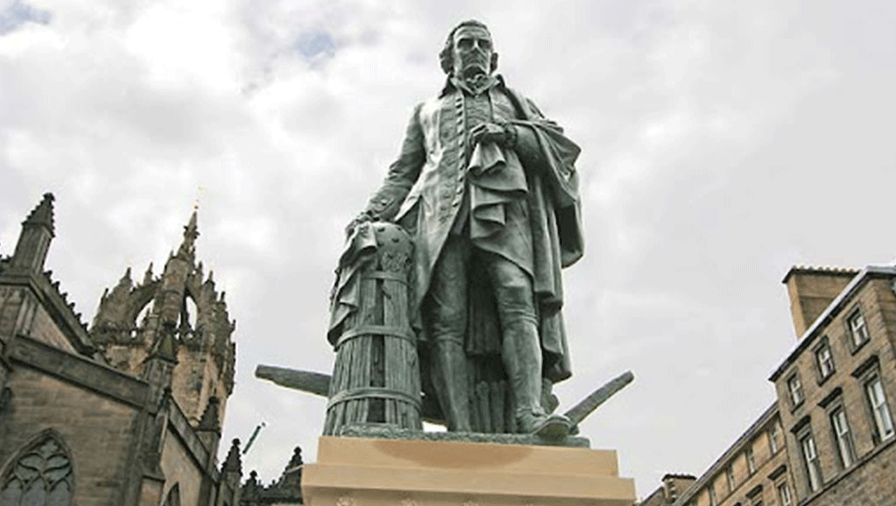
Adam Smith’s statue in the Royal Mile, Edinburgh.
‘Hidden hand’
Smith pointed this out about the capitalist in his famous 'hidden hand’ quote: “By pursuing his own interest, he frequently promotes [the good] of the society more effectually than when he really intends to promote it.”
Ever since, the study of economics has also been about human behaviour, as well as understanding how society works. Later, economics became highly mathematical before it turned full circle back to recognising Smith’s observations that humans could be fickle and irrational when pursuing their self-interest.
The modern academic discipline of behavioural economics began with findings informed by psychology, which was unknown in Smith’s day and considered with scepticism by economists well into the 20th century.
One concept, going back to Utilitarian philosopher Jeremy Bentham, was loss aversion, in which a situation is perceived as worse if it is framed as a loss rather than a gain. Another was the 'expected utility' theory, which was developed by mathematicians in the mid-20th century to explain decision-making under pressure.
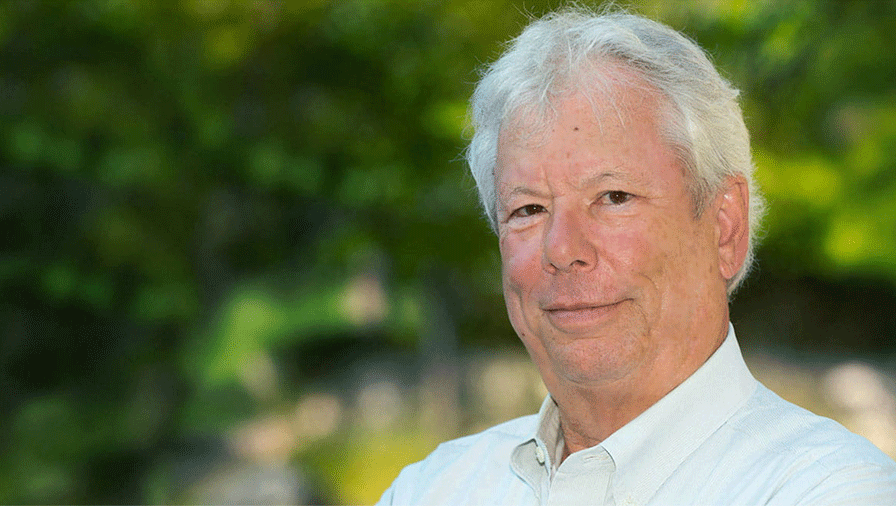
Richard Thaler. Photo: Chicago Booth School of Business.
This assumes that people should act rationally to maximise usefulness. A French economist, Maurice Allais, and then two Israeli psychologists, Daniel Kahneman and Amos Tversky, questioned this, saying that in real life, people acted irrationally. This led to the 'prospect theory' as a counter, thus setting off a whole new field of research. (The place to start is The Undoing Project (2016) by Michael Lewis about the Kahneman-Tversky collaboration.)
It culminated, in 1992, with the publication of The Winner’s Curse, a compendium of academic journal articles by Richard Thaler and eight co-authors, including Kahneman and Tversky. These quarterly columns focused “on economic anomalies, which would be defined as empirical observations that were inconsistent with standard economic theory”.
The catchy title introduced a wider readership to a raft of new and old concepts. They included those already mentioned as well as others such as 'the endowment effect', 'mental accounting', and 'the law of one price'.
Thaler’s lifetime of work was recognised in 2017 with the Nobel Prize in Economics. The selection committee said it was due in part to the reconciliation of the “deep tension between” Smith’s early views on moral sentiments and imperfect rationality, and his later ones of rationality and market forces.

Richard Thaler receives his Nobel Prize medal from King Carl XVI Gustaf of Sweden.
Better decisions
Before this, Thaler, with co-author Cass Sunstein, had boosted his profile with Nudge (2008), which discusses how public and private organisations could help people make better decisions in their daily lives.
An example relevant to New Zealand is that KiwiSaver uses 'opt-in' enrolment to overcome inertia on retirement savings, while retaining the freedom to 'opt out'.
A new edition of The Winner’s Curse expands on the original book while also updating it with more recent research as well as analysing whether the selected anomalies have stood the test of time.

Atlantic Richfield oil rig in Alaska. Photo: Anchorage Museum.
Perhaps surprisingly, Thaler and his younger co-author Alex Imas, who was born in the one-time Soviet republic of Moldova, say: “We found that all the critical conclusions about anomalies have held up remarkably well, even after decades of subsequent research”. Both are based at the Chicago Booth School of Business.
The title refers to the common practice of governments auctioning oil drilling rights. In this case, Atlantic Richfield had relied on experts to predict how much oil it would find, and therefore how much it should pay.
Winning bid
When it won an auction, Atlantic Richfield usually found less oil than expected. This was because a winning bid was always more than the average of all the others. That tended to be a more accurate measure. Moreover, the greater the number of bidders, the more likely the winning bid was too high.
Evidence from oil auctions was replicated by estimations of the value of coins in a jar, profits from a corporate takeover, and even the returns from buying a chunk of radio spectrum. The draft process for professional sports athletes is another example of the “winner’s curse”.
Other recognisable examples involve the payment of credit card debt and the choice of health insurance policies. Logically, consumers should first pay off the card with highest interest rate, but they don’t.
“People tend to repay a credit card by allocating their debt repayments proportionally to the relative sizes of their balance,” the authors say. Not only that, but they will also keep money in a low-interest bank account rather than pay down high-interest debt.
In health insurance, I was recently faced with a choice of premiums based on excess levels. I hope I made the right decision, but many consumers don’t, according to the research. A majority also tend to opt for cheap appliances that use more power than spending the difference on more efficient and longer-lasting models.

People treat cash windfalls as different from earned income.
Such examples are explained in two behavioural concepts: loss aversion and self-control. Similarly, 'mental accounting' is the term used when people treat ‘fungible’ (replaceable) money differently depending on its source.
A windfall is mentally accounted as different from income and is therefore likely to be saved or spent on something appropriate to its extraordinary status. At the same time, people will opt for instant gratification over longer-term benefits.
Other anomalies, such as those involving decisions between self-interest and public good, show a high degree of cooperation when fairness and ‘free riding’ are an issue. In game theory, it is assumed people will be less likely to opt for cooperation the longer the game is played.
Thaler and his associates found this was not the case if they didn’t think others were taking advantage of them. Emergency situations, such as panic buying of petrol or toilet paper, are tailor-made for behavioural economists.
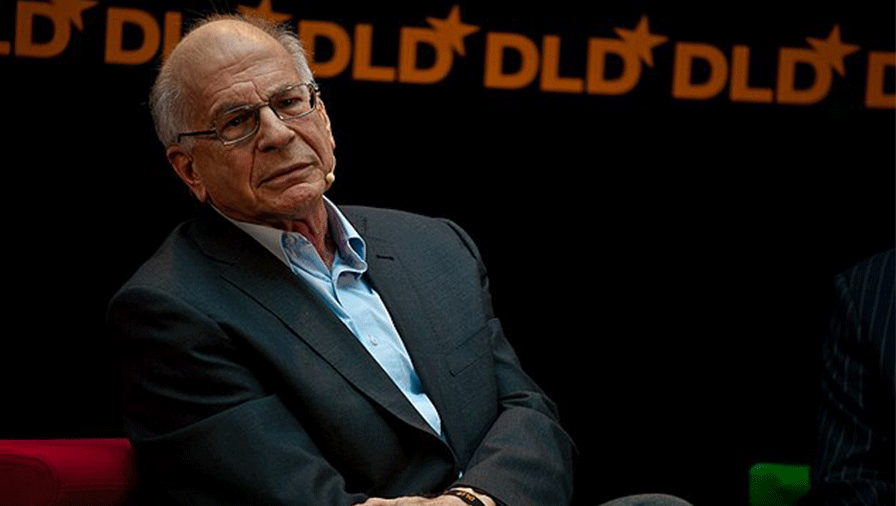
Daniel Kahneman.
Cognitive bias
These and many more examples have generated a rush of bestsellers on money and decision-making. They range from Kahneman’s Thinking, Fast and Slow on cognitive biases to the gee-whiz popularism of the Freakonomics series, by Steven Levitt and Stephen Dubner.
Somewhere in the middle are Noise, on the variability of judgments, by Kahneman (also a Nobel Prize winner) and Sunstein (with Olivier Sibony); Animal Spirits, by Nobel laureates George Akerlof and Robert Shiller; and Tim Harford’s The Logic of Life.
Some are more accessible than others. Thaler says his anomalies columns were “written in a way that any economist, or even undergraduate economics major, could understand them”. This is an understatement when it comes to the general reader.
The Winner’s Curse deserves respect because it is built on evidence, even if in the early stages it resembles putting economics students through a series of brain teasers. Behavioural economics has changed the way many political parties and policymakers have approached issues. The bibliography runs to 21 pages.
Thaler complains that mainstream economics textbooks still stick to the standard model and don’t provide space for demonstrations of human inconsistency “despite the empirical robustness and conceptual importance of these findings”.
In a measure of the behaviourists’ self-deprecation, Thaler is quoted as explaining the difference between himself and Robert Barro, a rationalist: “Barro assumes the agents in his models are as smart as he is, while I portray people as being as dumb as I am.” Barro agreed with this assessment.
The Winner’s Curse: Behavioural economics – then and now, by Richard H Thaler and Alex O Imas (Simon & Schuster).
Nevil Gibson is a former NBR editor-at-large.
This content was supplied free to NBR.


