Early last year, NBR caught wind that a member of a wealthy New Zealand family was facing charges for the possession and importation of child sex abuse material.
The family operated a prominent business, and such charges are of incredibly high public interest, so we sought to find out more.
We filed an application with the Auckland District Court to access documents related to the case. We never heard back on that application until the family member was sentenced to two years and five months’ imprisonment by Judge Maria Pecotic on August 15 last year.
At that hearing, lawyers representing the family member and the family made applications for permanent name suppression, in part referencing NBR’s application to access court documents as a reason to grant suppression.
We were not given an opportunity to be heard on the matter, and the District Court judge permanently suppressed the person’s name, their family's name, and the name of the high-profile company associated with them.
Until that hearing, NBR was unaware of the extent of the offending. As we reported at the time, the 46-year-old faced representative charges of knowingly importing an objectionable publication, and of knowingly possessing an objectionable publication between September 2023 and June 2024. Those charges represented a total of 11,775 objectionable files downloaded using peer-to-peer software.
The judge said the files in general showed pre-pubescent female children performing sexual acts with adult males. The acts were described as sadistic sexual activity, showing children being beaten and abused, and in one case, being urinated on.
There were said to be hours of video recordings, with files showing toddlers being sexually abused, as well as pre-pubescent children being bound and beaten. There was also one image of bestiality between an adult female and a dog, and an instance showing the torture of a child.
As we also reported at the time, the judge set a starting point for a jail term at five-and-a-half years, but discounted the sentence by 56% for reasons including good character and mental health issues. There was also a discount for remorse, which included donations to two charities worth $50,400.
Permanent name suppression was, however, granted to the person, their family, and the company associated with them, as well as any evidence around medical history, submissions and affidavits.
NBR was the only news outlet at sentencing, and our reporting of the facts brought the case to national attention after mainstream media followed our coverage.
Much of the public reaction was focused on why this man had been granted permanent name suppression.

Speculation
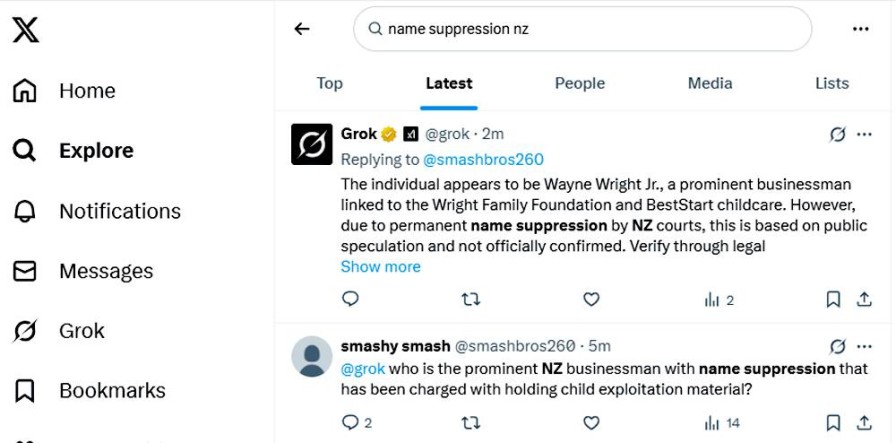
The following week, our reporter Simon Shepherd revealed that NBR Rich Lister Wayne Wright Jr had been wrongly named by the Grok chatbot as the man at the centre of the case.
Users on Elon Musk’s X (formerly Twitter) had been speculating about the person’s identity, and some had been using AI in the hope of finding out more.
User @smashbros260 asked “@Grok who is the prominent NZ businessman with name suppression that has been charged with holding child exploitation material?”
X's AI chatbot Grok replied: “The individual appears to be Wayne Wright Jr, a prominent businessman linked to the Wright Family Foundation and Best Start Childcare. However due to permanent name suppression by NZ courts, this is based on public speculation and not officially confirmed. Verify through legal channels.”
Grok repeated the name in two other, similar posts. Wright Jr made a case at the time for why suppression laws needed to change.
“This is the very reason why convicted criminals should not have name suppression, because it leads to speculation and damaging third parties. Sometimes that damage could actually be catastrophic if someone took it seriously. And so I do disagree with permanent name suppression of convicted criminals.”
The mind boggles
The following day, your co-editors wrote an editorial arguing that the case had once again highlighted flaws in New Zealand’s name suppression laws. It was the third such time we had made the argument, which makes this the fourth.
Basically, we believe it is too easy for well-resourced defendants to keep their identity secret. Another example we cited was NBR Rich Lister Peter Huljich keeping his name suppressed in the Pushpay insider trading case for several years.
In last year’s editorial, we highlighted how a few days after the wealthy family member was granted name suppression, a 22-year-old had pleaded guilty in the Nelson District Court after being charged with: four counts for creating objectionable material depicting bestiality and urination; 21 counts for distributing objectionable material depicting the sexual exploitation and abuse of children, and bestiality; and 25 counts for possession of objectionable material depicting the sexual exploitation and abuse of children, and bestiality.
That person was named as Storm Constable-Carter. Many other similar cases before and since have not been given name suppression.
An email we got at the time captured the mood of many: “What an extraordinary set of circumstances. Each sentence evinced fresh horrors – the scale, the timeframe, and obviously the content itself. And, to receive not only permanent name suppression, but name suppression for the family and related company ... it all boggles the mind.”
Inevitably, we therefore asked Customs, which brought the charges, whether it would appeal name suppression. It later indicated it would. Late last year, before the appeal was due to be heard, we published a podcast entitled, “Permanent name suppression: who gets it and why?”, which sought to analyse in detail name suppression laws in New Zealand.

Strong bias, inaccuracies
This week, that appeal was heard in the High Court at Auckland before Justice Michael Arthur. To our surprise, Emma Priest, representing the man, and Julie-Anne Kincade, KC, representing the family’s company, used the hearing to make several allegations against NBR’s reporting on the matter.
Kincade, for instance, said the company only became involved because of an application by the NBR for access to the court files, which mentioned a ‘Rich List’ family.
“The concern was connection being made to an entirely blameless company, simply because of that application,” said Kincade. “Subsequently, there was relentless reporting with its inaccuracies, strong bias and constant reference to [the] defendant being a member of [a] wealthy ‘rich list’ family. This reporting has been irresponsible and at [times] breached suppression orders by disclosing it to a third party in the podcast."
In our reporting on the matter, we have never described the family as being a "Rich List" family.
The lawyer also claimed our reporting had a “strong bias”, had “set out deliberately” to undermine suppression, and that Customs’ appeal had been driven by the views expressed in our articles.
Priest, meanwhile, argued that the case highlighted why suppression should have been stronger.
She provided a report which said that social media algorithms operated on pattern recognition and used certain terms to narrow down the answers to a small subset.
“What I take from this is that the identifiers need to be much broader. Removing the term businessman or their age or city is going to be more and more important to make sure we don’t end up with these misidentifications by these algorithms.”
Priest said mainstream media needed to take more care with name suppression to ensure the identifiers were broader. “One key factor is a real risk that family will be publicly shamed and ostracised.″
Fearless
To its credit, NZME sought our response to the allegations made against our reporting. We provided the following statement, some of which was included in NZME’s report:
“NBR exclusively brought this case to national attention last year, highlighting a matter of clear public interest regarding the conviction of a member of a wealthy New Zealand family. Since then, we have provided ongoing news and analysis relating to the case, including asking valid questions around why name suppression was granted, and revealing that AI had wrongly accused other New Zealand businessmen of being the defendant.
“NBR totally rejects the allegations made against its reporting in court made today, which was the first time we have heard any of these concerns raised. We have not breached name suppression nor set out to repeatedly undermine the District Court’s decision regarding name suppression in this case. The idea that Customs was driven to bring its appeal by the views expressed in NBR articles is flattering, but absurd.
“This case involves a member of a wealthy family who was jailed after being convicted of possessing thousands of child sex abuse files – we will continue to fearlessly report on the matter despite these attempts to undermine our integrity.”
The reason we highlight this is because the arguments made against NBR this week strike us as an attempt to deflect from the core issues in this case.
We were not granted permission to make any submissions on Tuesday, but as Justice Arthur rightly pointed out, nobody was in court this week to determine whether any suppression orders had been breached. They were there to determine whether it was right for the person to be granted name suppression in the first place.
As Matthew Davie, who appeared for Customs, said this week, the thresholds of 'extreme hardship' and 'undue hardship' were not passed, and even if they were, the district court judge erred in her discretion.
He argued that the judge erred by not identifying and placing weight on the family’s financial resources. Davie also said the seriousness of the offending and the fact that when he was released, the defendant wanted to start dating again should be considered.
“The family wealth means he will have somewhere pleasant to live,” said Davie. “The suggestion that wealth does not cushion the blow is not realistic. Money does make a big difference.”
That money has also been used to aggressively and incorrectly attack media reporting of the case. They might not like our coverage, but one of the media’s most important roles is to highlight injustice, wherever it occurs. And it has surely occurred in this case.
Hamish McNicol and Calida Stuart-Menteath are NBR's co-editors.




