Happy Wednesday and welcome to your morning wrap of the latest political and business headlines from around the world.
First up, US President Donald Trump says he was an “hour away” from deciding to launch new strikes on Iran before he postponed the attack yesterday at the request of three Arab states in the Persian Gulf, CNN reported.
Trump said in a post on social media that the attack was called off after the leaders of the United Arab Emirates, Saudi Arabia and Qatar urged him to hold off in hopes of finding a diplomatic answer to the conflict.
When the US president was pressed by reporters on leaders’ concerns that a renewed strike could prompt Iran to retaliate against other countries, Trump acknowledged it was a risk. “They still have a little capacity,” he said of Iran’s ability to attack others in the Middle East. “Not much, but they have a little.”
Trump said he was willing to wait another week to see if talks progressed, but continued to dangle the possibility of resuming the attack.
Iran submitted a response to the latest US proposal yesterday, via mediator Pakistan, to end the war.
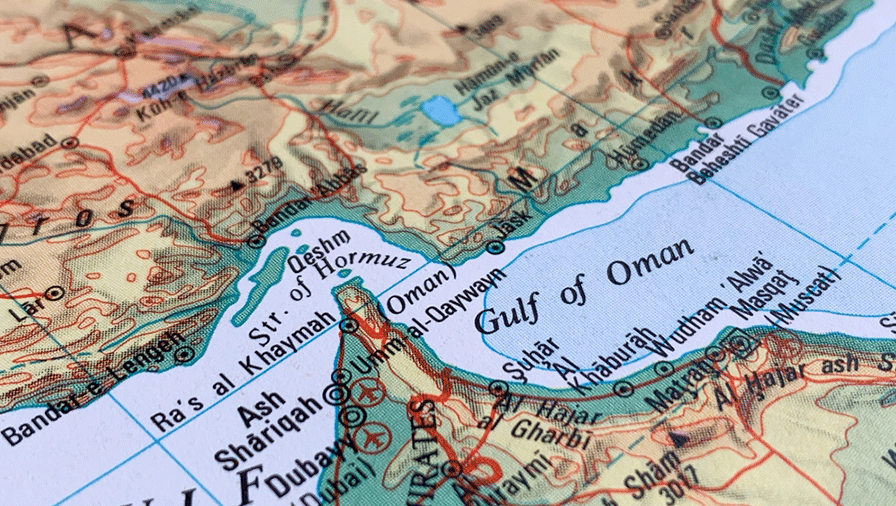
The Strait of Hormuz is a narrow channel through which about 20% of global oil flows.
In market news, the 30-year US Treasury has hit its highest level in nearly 19 years as investors dump the asset on fears of resurgent inflation. The long-dated bond yield rose six basis points overnight to 5.198%, its highest level since July 2007. Bond yields have an inverse relationship with bond prices.
Meanwhile, the yield on the 10-year US Treasury, which is a key benchmark for mortgage and auto loans, and the two-year US Treasury, which is an indicator of Federal Reserve interest expectations, both picked up.
CNBC reports the rise in yields follows a string of reports last week suggesting inflationary pressures were picking up, as rising oil prices tied to the war in the Middle East spill over into other parts of the economy. The development has spooked the market, causing investors to reprice their interest rate and inflation expectations, and ultimately demand a higher premium for owning US debt.
“When we started this year, everybody expected rates to come down — that was part of the bull case,” Morgan Stanley Wealth Management senior vice president Jim Lacamp told CNBC. “Now, it looks like we’re going to see a rate hike.”
The rise in yields is also flowing through to the equity market, with Wall Street’s main indices sliding overnight. The S&P 500 was down 0.34%, the tech-heavy Nasdaq fell 0.47%, while the Dow Jones eased 0.35%.
In other news, the director-general of the World Health Organisation says he is “deeply concerned” about the spread of a rare type of Ebola in eastern Congo, Associated Press reported. There are now at least 134 suspected deaths and more than 500 suspected cases.
The virus spread undetected for weeks after the first known death as authorities tested for a more common type of the virus, which came up negative.
WHO Director-General Tedros Adhanom Ghebreyesus said he was “deeply concerned about the scale and speed of the epidemic”, and pointed to the emergence of cases in urban areas, the deaths of healthcare workers, and significant population movement. Congo is expecting a shipment of an experimental vaccine for different types of Ebola.
To China now, where Russian President Vladimir Putin has arrived for what is his 25th state visit, according to Chinese state media, just four days after Beijing hosted Donald Trump, The Guardian reported.
International Crisis Group senior analyst William Yang said China hosting two of the most powerful leaders in the world in a matter of days shows its confidence in its place in the world.
He said Xi “likely wants to remind Trump that Beijing has other solid and robust relationships that it can count on, so Washington can’t easily isolate or harm Beijing if it tries to”.
Analysts will be watching to see if the two countries agree to any deals to further deepen energy cooperation. The most high-profile project under consideration is the Power of Siberia 2, which is a 2600-kilometre natural gas pipeline that would add 50 billion cubic metres of gas capacity to Russia’s flow to China. The pipeline would run through Mongolia and is viewed as key to making up for Russia’s lost exports to Europe.
Finally this morning, US home improvement retail giant Home Depot said its core customers remain resilient in the face of higher gas prices and plummeting consumer confidence. “The homeowner in a relative sense is perhaps more protected financially than other customer cohorts, and so we continue to see engagement,” Home Depot chief financial officer Richard McPhail told CNBC in an interview.
He said shoppers were engaged “up to a certain point” amid rising geopolitical tensions, plummeting consumer confidence and a broken housing market. “They continue to tell us that they are going to defer their spending on larger projects,” he said. “That’s consistent with what they’ve told us the last few years.”
His comments come after the big-box retailer exceeded Wall Street’s earnings-per-share and revenue expectations for the company.

