Happy Thursday and welcome to your morning wrap of the latest business and political headlines from around the world.
We begin again with the war in the Middle East, where overnight a US submarine sank an Iranian warship off the coast of Sri Lanka, the BBC reported.
US Defence Secretary Pete Hegseth, who announced the attack, said the US sank an “Iranian warship that thought it was safe in international waters”.
It is thought that about 140 people were on board the Iris Dena and 32 have been rescued, while Sri Lankan authorities told the BBC 80 bodies had been found so far.
The Associated Press quotes Hegseth saying the timeline for the conflict could be longer than first thought. “You can say four weeks, but it could be six, it could be eight, it could be three,” he said. “Ultimately, we set the pace and the tempo.”
He also acknowledged that the US could not fend off all of Iran’s drone attacks.
The BBC reported that explosions continue to ring out in Beirut as hostilities between Israel and Hezbollah escalate, with the death toll in Lebanon rising to 72. The United Nations peacekeeping mission in Lebanon has told the BBC that the Israeli military has entered several Lebanese villages near the Blue Line, which is the UN-demarcated boundary between the two countries.
In Iran, the country’s president, Masoud Pezeshkian, in a post on social media, told neighbouring Gulf countries that Iran had “no choice” but to respond to US and Israeli attacks. Iran launched more missiles at Israel, according to the IDF.
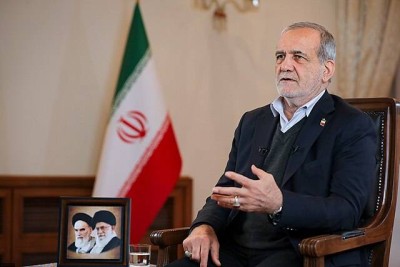
Iranian President Masoud Pezeshkian.
The conflict appears to be expanding in the Middle East, as a Turkish official said Nato defences intercepted a ballistic missile launched from Iran before it entered Turkish airspace, Al Jazeera reported.
Meanwhile, the Spanish prime minister has doubled down on his opposition to the joint strikes on Iran by the US and Israel, warning that Donald Trump was playing “Russian roulette” with the lives of millions of people, The Guardian reported.
Pedro Sánchez was responding after the US president threatened to cut trade with Madrid after it condemned the attack and refused to let the US military use its bases for missions linked to strikes on Iran.
“The position of the Spanish government can be summarised in four words: no to the war,” he said in a televised address to the nation.
To Wall Street now, where financial markets have bounced after yesterday’s sell-off.
The three main indices are all up between 0.7% and 1.4%, as oil prices retreated following the latest fears about US economic growth, CNBC reported.
US equities were supported by a couple of economic data releases which showed that private sector companies added more jobs last month than expected, and the non-manufacturing sector recorded better-than-anticipated growth in February, with inflation pressures easing.
Brent crude oil, which is the international benchmark, is back around US$81 a barrel, down from about US$83.
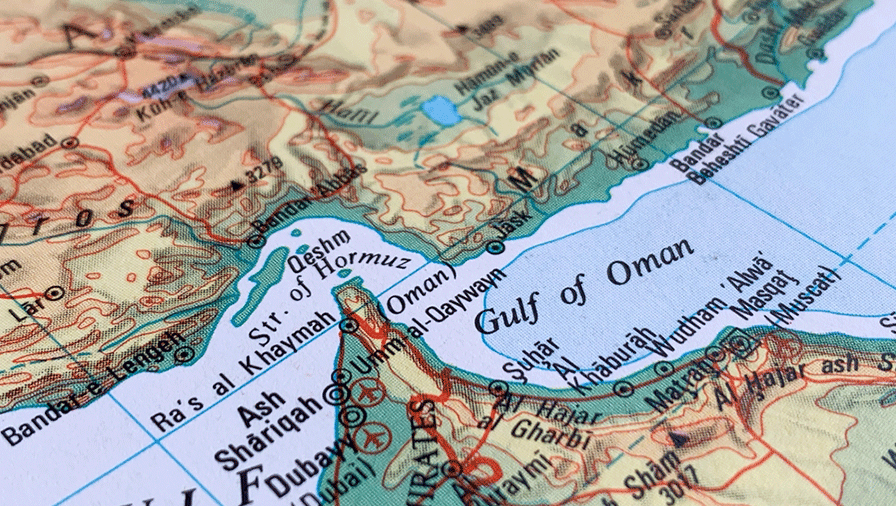
The Strait of Hormuz is a narrow channel through which about 20% of global oil flows.
The easing in oil’s recent rally came a day after Trump said the US would provide risk insurance to all maritime trade through the Gulf, to get tankers moving through the Strait of Hormuz.
“We are in the headline-watching business at the moment, with competing stories shifting market sentiment on an hourly basis yesterday,” Deutsche Bank’s Jim Reid wrote in a note. “From a market perspective, the main issue is that there’s no sign of either side de-escalating, and if anything, it looks as though things are still ratcheting up.”
Gold has ticked back up by 0.5% to US$5150 per ounce, while Bitcoin rose 7% overnight to be back over US$70,000.
In other news, US Treasury Secretary Scott Bessent said the global tariff the White House imposed following its Supreme Court defeat will probably be lifted to 15% from 10% this week, the Financial Times reported.
The White House turned to a new series of laws to resurrect Trump’s tariff regime after the Supreme Court ruled last month that the majority of the levies imposed by his administration were illegal.
Trump was furious at the ruling and imposed a fresh 10% global levy for 150 days, which he later said would rise to 15%.
Bessent told CNBC the higher rate would “likely” happen this week.
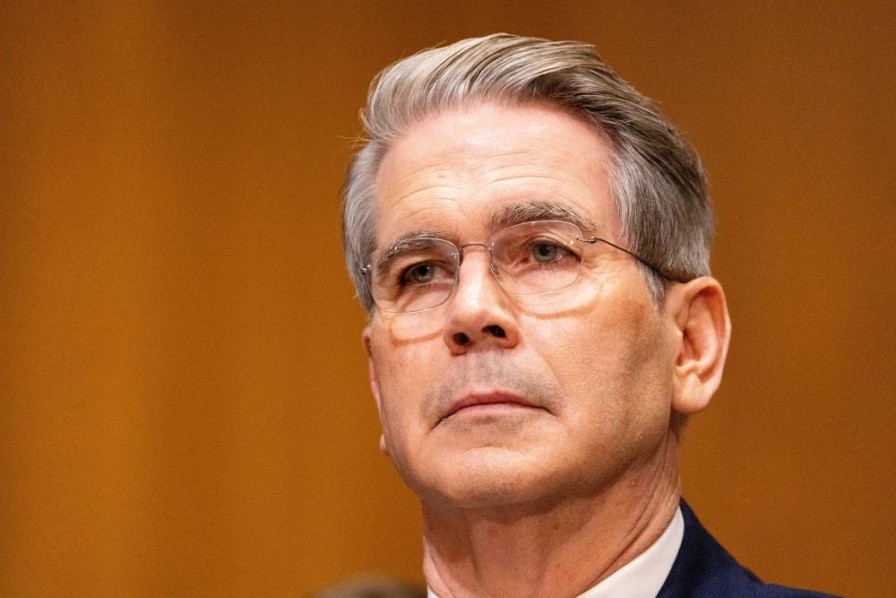
Scott Bessent.
Finally, some Anthropic investors are racing to contain the fallout from the AI research lab’s dispute with the Pentagon out of fear that an ongoing feud could devastate its business, Reuters reported.
Donald Trump ordered the government to stop using Anthropic, calling it a threat to national security, after it refused to agree to unconditional military use of its Claude models.
The firm vowed to sue over “intimidation”, insisting its technology should not be used for mass surveillance or fully autonomous weapons systems.
According to the exclusive report from Reuters, in which it spoke to several investors and people close to the company, some investors have been reaching out to their contacts in the Trump administration in the hope of cooling tensions.
The discussions focus on avoiding a ban on Anthropic’s AI by all Pentagon contractors. Meanwhile, talks between the company and the Pentagon are continuing.


