The Government finances continue to be in better shape than forecast in the December half-year economic and fiscal update. For the nine months to the end of March the operating balance before gains and losses excluding ACC (Obegalx) recorded a deficit of $7.8 billion, $2.1b smaller than forecast. Once ACC was included the deficit was $8.4b, also $2.1b smaller than forecast. But poor investment returns meant the operating balance was $1.1b larger at $2.9b. The residual cash deficit, however, was smaller than expected and net core Crown debt was $3.4b lower at $187.8b, or 42.2% of GDP. The net worth of the Crown was down $400 million on forecast at $177.2b, largely reflecting the lower-than-expected operating balance.
Wednesday May 13
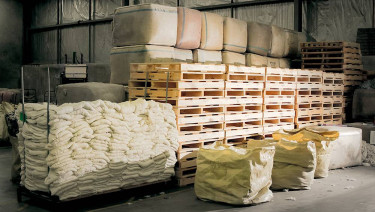
Rubisco bales.
Rubisco lands Arowhenua backing
Te Rūnanga o Arowhenua Limited has made a multimillion-dollar strategic investment in Rubisco, the New Zealand natural fibre processor. Rubisco said the investment would support further growth in manufacturing capability, processing systems, innovation, and in other natural material opportunities such as wool and hemp. The deal adds a Ngāi Tahu papatipu rūnanga commercial arm to a shareholder base that already includes Carrfields, Zealandia Hemp, farmers and other New Zealand investors. Rubisco said it was aiming to scale natural material solutions into textiles, interiors and buildings, while Arowhenua said the investment aligned with kaitiakitanga, resource stewardship and intergenerational outcomes.
Investors rally around Pacific Edge’s urgent offer
NZX- and ASX-listed cancer diagnostics company Pacific Edge has raised $24.5 million of new equity in a placement. Directors allowed oversubscriptions following strong investor demand. The offer was priced at 17 cents per share and is being followed by a $6m retail offer at the same price, which opens Thursday and is also open to oversubscription. Pacific Edge, which sells genomic urine biomarker tests that support the detection of new bladder cancer in patients presenting with haematuria, was running out of cash as its cash reserves had dwindled and revenue had fallen. It would have preferred to raise the money after a new draft determination from Medicare administrative contractor Novitas on reimbursement of its Cxbladder tests in the US, which stopped last April. The draft on haematuria evaluation is expected any time between now and September, and would have provided more certainty to investors.
Fair Trading Amendment Bill targets misleading pricing

Nicola Willis.
The Government is cracking down on deceptive business practices and unfair pricing through the introduction of the Fair Trading Amendment Bill. Economic Growth Minister Nicola Willis said the consequences would match the harm caused and the profit made. “The maximum penalty for breaches of the Fair Trading Act is currently $600,000. Following these changes, companies could be liable for up to three times the value of the commercial gain, the value of the transactions, or $5 million." Although most businesses followed the rules, some didn’t, she said, "which is where we’re seeing misleading pricing and promotions that short-change shoppers.” The Bill also introduces a new ‘safe harbour’ legal defence to support the takedown of scam websites, and streamlines the process of product safety standards. The Bill will be referred to a select committee.
Thursday May 14
Mbie reports gas reserves down 23%
New Zealand’s gas reserves have fallen 23% to 731PJ, the lowest level since recording began 20 years ago, says the Ministry of Business Innovation & Employment. The figure represents proven plus probable reserves, or 2P, as of January 1 this year. Mbie said half of the decline was gas used during the year, and half was a downward revision of estimated reserves. The biggest single operating field is now Turangi with 380PJ of 2P reserves, about 51% of the country’s total reserves. Gas field operators were expected to produce 85PJ this year, said Mbie, down 15% on the figure released a year ago for 2025 production. Mbie said the data showed contingent resources – gas known to exist but not considered commercially recoverable – were 1950PJ.

Visitor arrivals bounce back strongly in March
Migration to New Zealand has improved while visitor arrivals are back near pre-Covid levels, according to Statistics NZ data. The country recorded a net migration gain of 24,200 people in the year to March, up from a net gain of 14,000 the previous year, helped by fewer people departing long-term and an increase in arrivals. Visitor arrivals were 358,900 in March, up 47,100 on the same month last year. It marked the best March for tourism since 2019, when there were 378,300 visitor arrivals. The record for any March was set in 2018 with 388,300 arrivals. The latest increase was driven by more holidaymakers from Australia, China, the United States, and Britain.
ASX announces new chief executive
The ASX has appointed a former chief executive of Euronext Paris to replace outgoing chief executive Helen Lofthouse. The listed markets operator today announced Anthony Attia as its new managing director and chief executive, effective from September this year. Lofthouse announced in February that she would step down. The current group executive of markets and listings, Darren Yip, has been acting chief executive on an interim basis since May and will continue until September.
Western Bay of Plenty regional deal signed
The Government has signed its second regional deal, this time with the Western Bay of Plenty. Tauranga City Council, Western Bay of Plenty District Council and Bay of Plenty Regional Council are all part of the deal. Infrastructure Minister Chris Bishop said under the deal, the new sub-regional spatial plan would focus on growth around the Tauranga Eastern Link, developments in Omokoroa and Katikati and in Tauriko West. “Growth in these areas and in existing urban areas is estimated to support 12,000 greenfield homes and 3000 infill and intensified homes over the next 10 years, aligned with transport, water and community infrastructure,” Bishop said. The deal identifies the Takitimu North Link Stage 2 and the Tauriko West Roads of national significance as priority projects. Delivering social infrastructure alongside housing was a key focus of the deal, he said.
Friday May 15
Fletcher sells Iplex Australia site
 Fletcher Building has announced the sale and leaseback of another Australian property, this time Iplex Australia’s industrial site in Elizabeth, South Australia.
The property is being sold for A$20.05 million ($24m) to a property investor, with a 12-month leaseback “to facilitate the removal of its operations”.
Fletcher said the money would be paid in two tranches, the first in June and the second by September, with the deal generating a gain on sale of about A$10m.
The sale follows Fletcher’s announcement on May 8 it had sold Laminex’s property in Melbourne for A$53.8m.
Fletcher also said on Thursday it had sold its remaining 50% stake in its Fiji construction business to joint ventures partners Fijian Holdings and Fiji National Provident Fund. The price was non-material, it said.
Warehouse sales dip during the third quarter
Warehouse Group sales for the 13 weeks to May 3 reduced 1.4% to $700.8 million.
The Warehouse and Warehouse Stationery both recorded a decline in sales during the third quarter, while Noel Leeming sales rose 0.7%.
Warehouse Group chief executive Mark Stirton said rising fuel prices led to customers becoming more conscious of travel. While they made fewer shopping trips, they purchased more when they visited.
Group foot traffic declined 1.8% during the quarter.
The retailer reported higher costs, particularly across international and domestic freight, however, a spokesperson for the company declined to provide further detail.
Stirton said: “We’re doing everything we can to balance providing everyday value for customers while managing the impact of higher costs on our business. In this environment, our priority is to stay focused on what we can control.”
Government changes to Treaty references in existing legislation

Paul Goldsmith.
The Government will amend 19 pieces of legislation to ensure references to the Treaty of Waitangi are clear and consistent.
Justice Minister Paul Goldsmith said legislation made all sorts of references to the Treaty. “Sometimes it’s ‘honour’, or ‘have regard to’, or ‘give effect to’, or ‘take account of’.
“We need to create some consistency here, in the interests of increasing certainty and supporting compliance,” he said.
Goldsmith said the changes were being made as part of National’s coalition agreement with New Zealand First to review all legislation that included “the principles of the Treaty of Waitangi” and replace the references with specific wording or repeal them.
Of the 19 pieces of legislation, the Government has agreed to amend two to be more specific; repeal seven references; and specify that no higher standard than ‘take into account’ should be used in the other 10.
The Government is consulting iwi, and the changes will go through a full select committee process.
Govt extends protection for plant variety rights
The Government is strengthening plant variety rights (PVR), the plant-world equivalent of a patent. Commerce and Consumer Affairs Minister Cameron Brewer said 75% of the $3.5 billion of export returns from kiwifruit and about 55% of the $979 million returns from apples came from varieties protected by plant variety rights. “Zespri’s projections show that extending the PVR term by five years for SunGold kiwifruit alone would mean additional revenue of $1.8b over five years from the time of the extension to the kiwifruit industry and Biosciences Science Institute,” Brewer said. Under the Plant Variety Rights Act 2022 plant breeders and importers have exclusive rights over new plant varieties for up to 20 or 25 years. But a change to the law will increase that by five years. Agriculture Minister Todd McClay said by providing greater certainty and support, the Government was helping plant breeders to keep innovating.
Lines companies back away from integration plan
South Island electricity lines companies Aurora Energy and Alpine Energy have backed off a proposal to combine their operations. The companies announced a heads of agreement in December, saying a joint steering group had been established to work on an integration plan. A statement said: “Rather than investing separately in the same new skills, systems, capability and capacity, they are choosing to work together to combine their operations to deliver better outcomes for customers.” In a statement on Friday they said after assessment work, “both organisations concluded that the model does not deliver sufficiently compelling long-term consumer benefits to justify the cost, complexity, and risk involved”. Aurora, owned by Dunedin City Council, operates electricity distribution in Dunedin and Central Otago. Alpine – owned by Timaru, Waimate and Mackenzie District Councils, as well as LineTrust South Canterbury – runs the network in South Canterbury between the Rangitata and Waitaki Rivers.