The signing of the historic New Zealand-India free trade agreement (FTA) this week highlighted the gains in both countries. The downside of such agreements is limited, and the few critics ignore the evidence because they have a separate agenda.
Two aspects are worth examining: the historical role of free trade as the major generator of economic growth and human progress; and who wins out when parties are markedly disparate in size and development.
The NZ-India FTA is one of extremes for both parties. The issues raised by the New Zealand critics were fears of mass immigration and an unrealistic goal for a massive investment of New Zealand capital in India.
An Asia Media Centre survey of Indian media coverage found no discernible risks to their country. That is not surprising given its history of opposition to opening its borders to trade and its poor economic performance relative to its post-colonial peers.
On the other hand, New Zealand has benefited from all its FTAs, starting with the original Nafta with Australia and the most impressive one with China.
Evidence across a range of FTAs shows the smaller partner makes proportionally more gains, while the larger one benefits absolutely. This is because the smaller partner has a larger market for its goods and services. The larger partner measures its gains in strategic and political leverage, as its businesses get greater control over supply chains, investment flows, and standards setting.
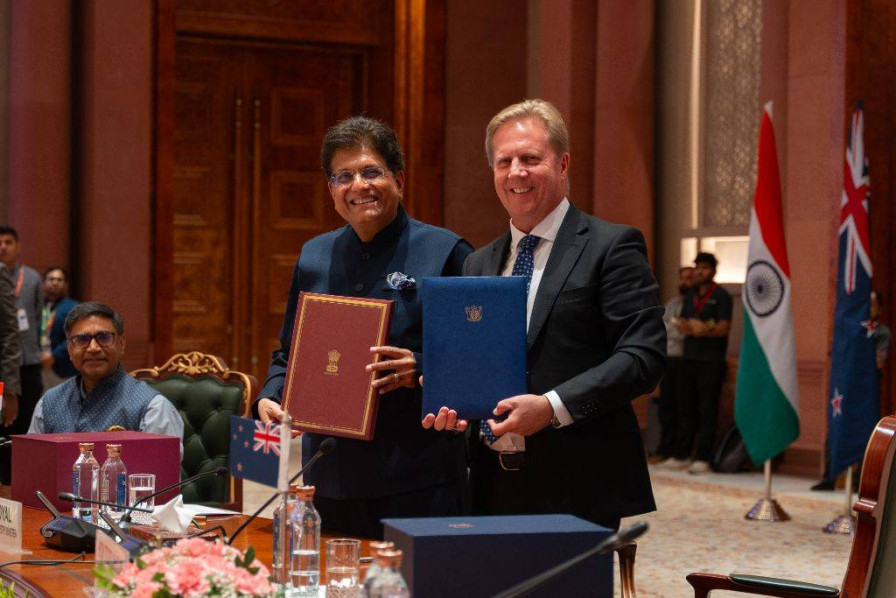
India Commerce and Industry Minister Piyush Goyal and New Zealand Trade and Investment Minister Todd McClay sign the FTA in Delhi.
Little difference
This is most obvious in FTAs involving the European Union and the United States. With developing economies such as China and now India, New Zealand can demonstrate that its record of increased exports makes little difference to those countries’ economies.
China benefited strategically from New Zealand’s endorsement of free trade benefits, even if China exploits its leverage in ways that undermine that belief. India has recently signed a raft of FTAs to burnish its desire to be recognised as a large contributor to the global economy.
It’s been too long in coming and, historically, restores a role India has played in the past, both in the Ancient World we associate with Rome and Greece, and more recently in the British Raj.
Two recent books, both from the Dalrymple family, have focused on India as an intermediary between the cultures of Asia and Europe over several millennia. William Dalrymple’s The Golden Road (2024) describes how Indian commerce and ‘soft power’ influenced modern civilisations from about 250 BCE.
His son Sam, born and educated in India, but also with degrees from Oxford, has complemented this scholarship with another definitive work, Shattered Lands. It describes the evolution of the Raj as the economic driving force of the British Empire and its decline through partition under decolonisation.
In this historical context, the NZ-India FTA can be seen as a small piece of Lego that helps restore what was for a century or so one of the world’s largest free-trading structures.

Sam Dalrymple. (Source: HarperCollins India)
Major achievement
Sam Dalrymple’s major achievement is to widen recognition of the Raj to make it comparable to the ancient empires of the past. In geographic terms, this means a single economic and political unit across a subcontinent from the Arabian Peninsula to the old Burma.
This area of 4.9 million square kilometres compares with 3.3m sq km of today’s India. The Raj represented four-fifths of the total British Empire at its peak and embraced a quarter of the world’s population. (This is more than twice the proportion of the Trans-Pacific Partnership, including the UK at 11%, the EU at 5.5%, and India at 18%.)
The Raj included protectorates such as Oman and Nepal, as well as the princely states of Arabia and India. These ranged in size from principalities to areas larger than France. All swore allegiance to the British Crown in return for the benefits of the empire, which included access to the technology and finance of the world’s leading superpower. This dispels claims to the contrary made for treaties signed in the 19th century with tribal entities.
Life under the Raj meant a single passport, a ubiquitous currency (rupee), and a civil service dedicated to promoting commerce. In the 1920s, Burma was the richest place in the empire, as oil had yet to become a staple of the Arab economies. Rangoon (now Yangon) was second only to New York as the world’s largest migrant city.
This was where the pressure for a breakup or partition began. Labour politician Clement Attlee joined the Simon Commission, which in 1928-29 travelled throughout the Raj to inform the British Government on its options to meet demands for self-government.
Burma was the first to leave the Raj in 1937, followed later that year by some Arab states from Yemen up to Kuwait. Once an anchor city of the Raj, Aden began its journey to insignificance. The same happened at the other end of the Raj to Rangoon, now one of the world’s poorest cities.
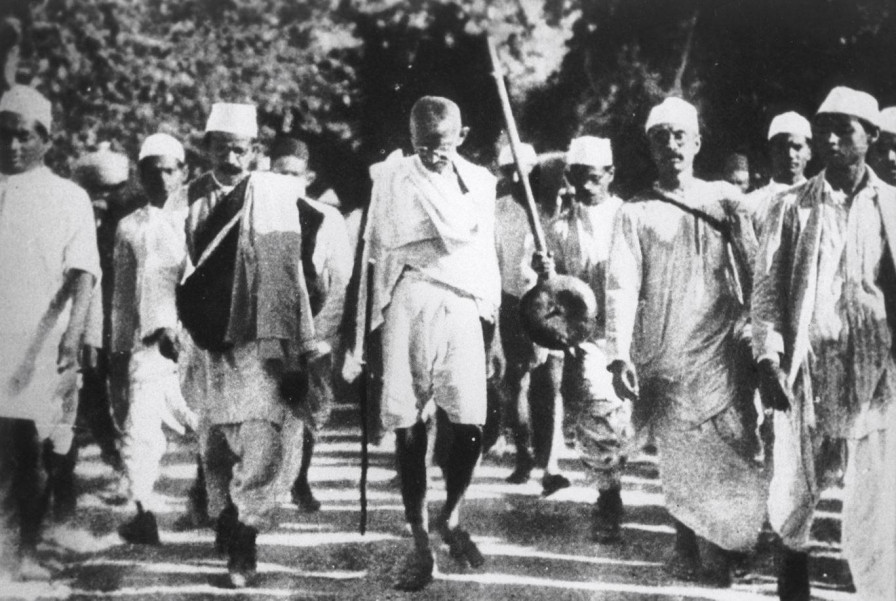
Gandhi’s Salt March in 1930 was a precursor to independence and partition. (Source: Wikimedia Commons)
Leading advocate
Few people symbolised the Raj as much as Mohandas Gandhi, born in Arabian India, educated in London, and an emigrant to South Africa in 1915. He toured the Raj in 1929-30, including a salt monopoly protest march, and transformed the Indian National Congress into the leading advocate for decolonisation.
This undermined the Raj’s pragmatic secularism, which catered for many religions and ethnicities. Eventually, it fell victim to nationalism combined with Islam or Hinduism. This culminated, in 1947, with the third and biggest partition of the Raj, splitting India and Pakistan.
“Partitioning India’s fluid landscape on the basis of religion would lead to violence on an epic scale, as unexpected as it was brutal,” Dalrymple says. This population upheaval dwarfed the million Indians expelled from Burma in 1937, many of them Muslims who ended up in divided Bengal. It was to be mirrored in the western part of the Raj on a much larger scale.
“As Punjab descended into mutual genocide, in the coming months tens of millions of people would be displaced across religious lines, creating ripples of mass sectarian violence and an overwhelming refugee crisis,” Dalrymple says. The borders were hastily drawn up to meet demands for Muslim self-rule and urgency from Attlee’s decolonising Labour Government.
This happened “haphazardly over just 10 weeks”, Dalrymple says, in contrast with the meticulous planning in the partitions of Burma and Arabia. The human cost vastly exceeded the atrocities attributed to the Raj and losses from fighting a Japanese invasion during World War II.
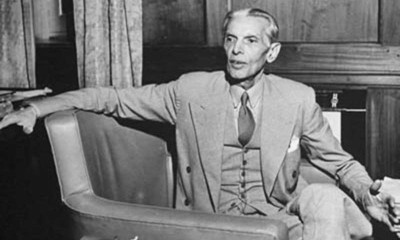
Muhammad Ali Jinnah.
Strengthened case
Hindu nationalists sided with Japan, while Muhammad Ali Jinnah strengthened his case for Pakistan by supporting the Imperial cause. All but a handful of 565 princely states, which ruled much of northwestern and central India, had little choice but to join the newly independent Indian federation, which ended up with almost as many Muslims as Pakistan.
Dalrymple’s fifth and final partition of the Raj is that of East Pakistan (Bengal) from western Pakistan to form Bangladesh after a civil war in 1971. In the same year, the last of the British protectorates in the Gulf achieved independence, the largest being the United Arab Emirates.
Despite decades of rule by the Indian Civil Service, India’s new rulers showed no interest in continuing a role in that region. “In hindsight, the negotiations read like India’s greatest lost opportunity, willingly giving up the combined oil wealth of Kuwait, Qatar, Bahrain and the UAE,” Dalrymple says. Today, the one-time masters of the Raj return as servants.
This wasn’t the only miscalculation in the decolonisation project, which is the underlying theme in Dalrymple’s extensive 490-page account, which is informed by a further 52 pages of source notes (incorporating a bibliography), 17 maps, and nearly 100 illustrations.
His conclusions apply as much to the problems in the modern Middle East as to the Indian subcontinent. Britain’s policy failure led to a Marxist takeover in Yemen, triggering the collapse of Aden and the neighbouring princely Arabian states. Dalrymple quotes from the memoirs of a British diplomat, Michael Crouch, who described the betrayal as a mix of “incompetence and immorality”.
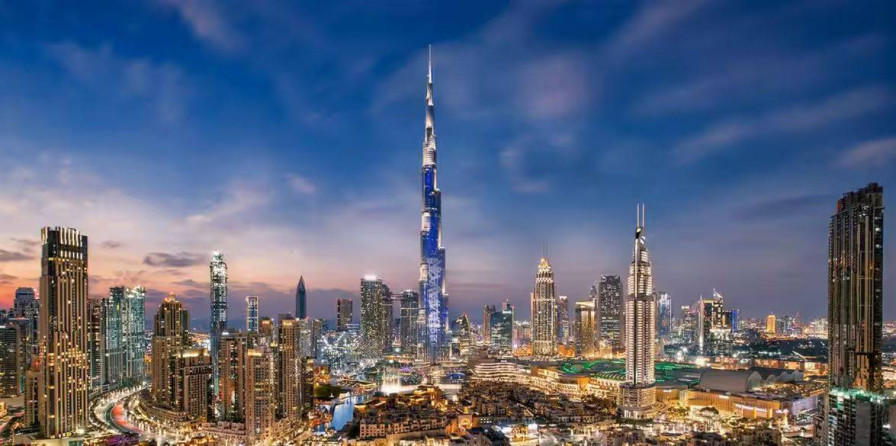
Once masters of the Arab Raj, Indians now return to Dubai as servants.
Fared better
Further north, the Gulf states fared better after the British withdrawal and have become rare examples of prosperity in the Third World. This has come under threat in recent weeks in the joint American and Israeli attacks on Iran, a sponsor of terrorism throughout the region.
Conflict has also plagued the post-independence period in the subcontinent’s three partitioned states. The border between India and Pakistan – non-existent under the Raj – is now one of the most fortified in the world.
It’s a myth that the Great Wall of China can be seen from space. But not this border. “For more than 3000km, from the Arabian Sea to the icecaps of Kashmir, a line intended to divide Hindus from Muslims is visibly etched on to the surface of the globe,” Dalrymple says. “Three layers of fencing, 3.5m high, are accompanied by 150,000 floodlights, thermal vision sensors and rows of landmines.”
A similar barrier dividing India from Bangladesh is even longer, and a 1600km fence is being built between India and Burma (Myanmar). It is easier for related Indians and Pakistanis to meet in the UK (or New Zealand) than in their home countries.
This has inspired Dalrymple and others to form Project Dastaan, an initiative that uses virtual reality and animation to reconnect partition survivors with their childhood homes. A sad legacy to a counterfactual vision of a Raj that could have created a united Nations of South Asia.
Shattered Lands: Five Partitions and the Making of Modern Asia, by Sam Dalrymple (William Collins).




