There has always been an expectation – a requirement, really – that government departments which wield great power should be careful to play by the rules.
One department which has great power is Inland Revenue. Those who have got offside with the Government’s tax collector can attest to how difficult that can be.
If the IRD expects people and businesses to play by the tax rules, it is not asking much for it to play by the rules, too. Which is why its admission that it shared NBR articles with hundreds of staff, in breach of the publication’s copyright, is so extraordinary.
In IRD’s case, it had previously had a group subscription for 220 users. It cancelled that subscription in March last year and took out a single subscription for IRD media principal Rowan McArthur.
It appears it wanted to have the best of both worlds: a low subscription fee but still access for hundreds of staffers. Between the end of March last year and November 17 this year, it shared 22 different NBR articles with staff members. Seven of those articles were shared with 600 staff.
So, this is no simple mistake. It is a clear deception aimed at minimising its cost while still getting access to the same – if not a greater – service that it had previously paid for.
A business that took similar sorts of steps to avoid paying tax would surely face the ire of the IRD, just as the tax collector is now facing the ire of NBR’s publisher, Todd Scott.
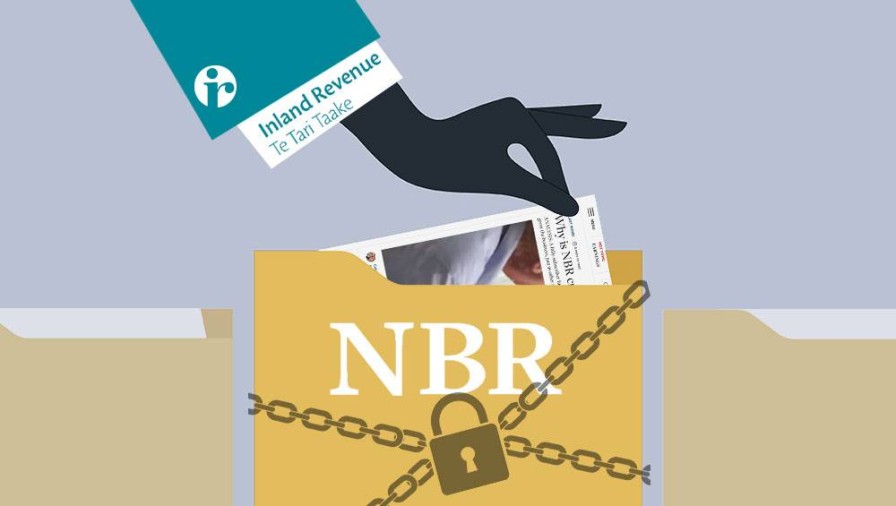
The IRD has breached NBR’s copyright by sharing articles with staffers who did not have subscriptions.
Deeper problems
It also points to deeper problems within the public service about appropriate and ethical conduct. Responsibility for some of that might be driven home to the public service’s political masters.
Presumably, IRD cancelled its group subscription last year as the Coalition Government put the heat on its agencies to rein in spending. What better way to do that than to cut subscriptions but still have access to NBR articles for a wide number of staff members? The same way a business might want to cut costs by getting around its tax bill, possibly by hiding income or not declaring it?
What other shortcuts are government agencies taking, particularly those that wield power over the country’s citizens?
This appears to be a clear breach of the Public Service Commission’s code of conduct for public servants. It says public servants are expected to act in a spirit of service to the community and “meet the same high standards of integrity and conduct in everything we do”. That includes acting lawfully and objectively and being honest.
Surely that applies to departments, too, not just their individual employees.
It hardly seems honest to scrap a group subscription, then use a single subscription to pass articles on to those who presumably were previously covered by the group subscription. It does not seem that the IRD staff who made this decision met “the same high standards of integrity and conduct” on this occasion.
Did the IRD meet the Public Service Commission’s code of conduct for public servants?
Police conduct
This is not an isolated incident within the wider public service, particularly among those public servants charged with enforcing the law.
Take the revelations this year about the police hierarchy’s handling of complaints against former Deputy Police Commissioner Jevon McSkimming. While of a different nature, it, too, poses questions about the ethical judgment of senior public servants.
In that instance, their judgment was clouded by their close association with McSkimming. They effectively took his side in ignoring the allegations of the complainant, who instead was subjected to some heavy-handed police bullying.
Former Police Commissioner Andrew Coster alleges that he mentioned the issue to both former Police Minister Chris Hipkins, and current Police Minister Mark Mitchell, informally. Both deny this, but the point is that the matter was so serious that both ministers should have got a formal briefing in writing.
Again, it raises the question of whether senior police officers acted objectively and honestly when it came to dealing with McSkimming. It is unlikely any other citizen in the same position would have been treated so tolerantly.
Both IRD and Police wield great power over our lives. Public confidence and trust in government rely on a faith that powerful institutions such as these will act properly and that the elected representatives responsible for them will hold them to account when they err.
Last year, the Auditor-General’s office (OAG) released a report on integrity in the public sector, which stated the state sector’s power came with a responsibility to act lawfully and ethically. “If this responsibility is not fulfilled, the legitimacy of the public sector can be undermined,” the report said.

Former Police Commissioner Andrew Coster.
Public sector integrity
It went on to state how important public sector integrity was. “Trust in the public sector is essential for social cohesion and well-being because it underpins a government’s ability to govern. Trust enables governments to act without having to resort to coercion. Trust determines the levels of participation with public services and compliance with requirements. This ultimately provides public organisations with an ongoing social licence to operate.”
The focus of the OAG’s report is on how the public sector interacts with the citizens it provides services and support to. But its ethics and integrity must also relate to how it interacts with businesses providing services to it or how it deals with one of its own when they misbehave.
The police clearly fell short of the standards expected of them. In the case of IRD, it, too, has surely fallen short of the expectations set out by the Auditor-General’s Office.
It risks undermining trust in the public sector and, therefore, according to the Auditor-General’s Office, in the Government’s ability to govern.
Todd Scott should not be the only one angry at the IRD’s conduct.
Brent Edwards is NBR's political editor.




